
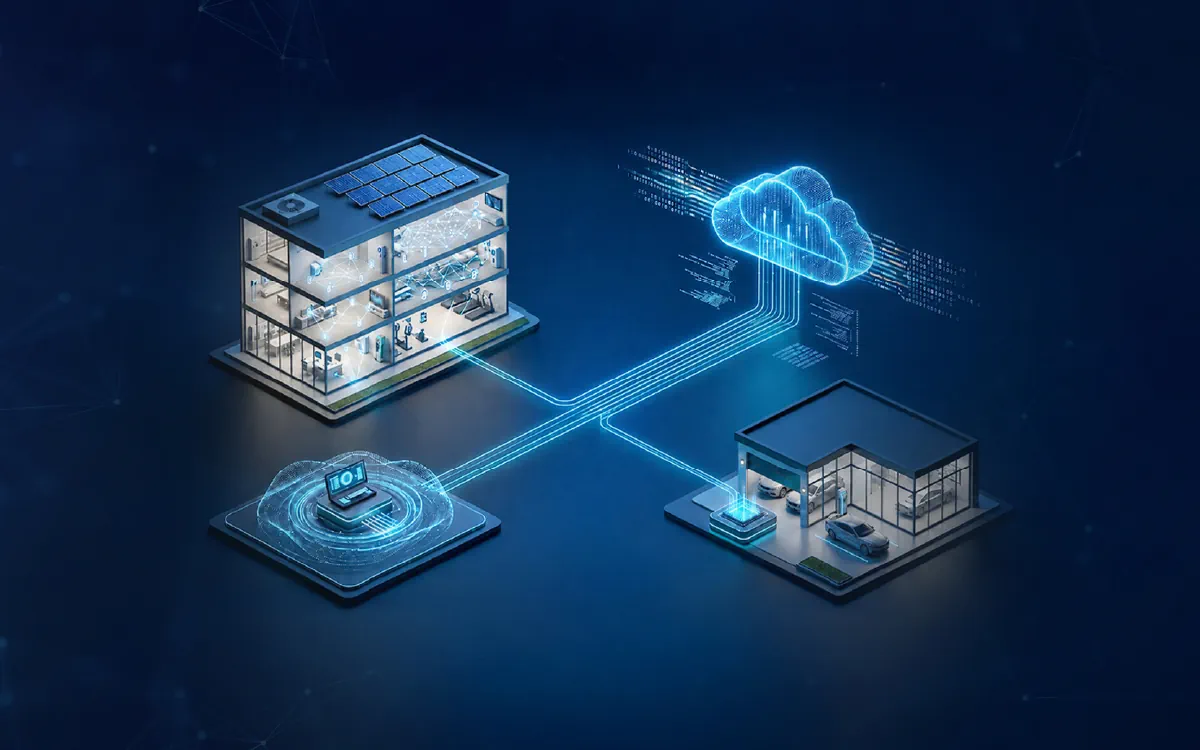
Modern smart home systems are no longer limited to apartments and single-family houses. Automation is increasingly being deployed in multi-story villas, residential complexes, hotels, commercial buildings, and geographically distributed locations.
Unlike traditional building automation systems that rely on extensive wiring and centralized infrastructure, our gateway linking architecture enables a fully wireless deployment using distributed gateways interconnected over an IP backbone. This approach allows large-scale environments to operate as a single, unified automation system while preserving flexibility in physical installation.
Traditional singe-gateway architectures become a limiting factor in such environments, particularly in terms of range, scalability, and reliability across complex building structures.
Our gateway linking architecture is a distributed system of interconnected gateway devices where each node manages a local wireless network (ZigBee, Matter, Z-Wave), while all gateways operate together as a unified automation system over an IP-based backbone.
In this model based on OBLO Gateway, multiple gateways collaborate as part of a single logical system rather than functioning as isolated controllers. This enables scalable deployment across large buildings or multiple locations, while maintaining a consistent user experience and centralized system behavior.
Background
In standard smart home systems, a single gateway device manages the entire network. This approach works well in smaller installations, but in large-scale buildings it leads to issues such as:
- limited wireless range,
- mesh topology congestion,
- increased communication latency,
- more complex device routing,
- instability in buildings with reinforced concrete structures,
- connectivity issues between distant buildings or floors.
Our gateway linking architecture addresses these challenges by dividing the system into multiple independent radio domains while maintaining a unified management model.
Solution Architecture
The system architecture is based on a distributed network of gateway devices organized in a star topology.
At the center of the system is the Main Gateway, which:
- maintains a central registry of all devices,
- executes automations and scenes,
- manages cloud synchronization,
- coordinates communication between gateway nodes.
One or more Bridge Gateway devices operate around it, with each managing its own local ZigBee or Z-Wave network. In addition, any protocol extender can be added to the system (e.g. Modbus specific bridge).
From the end user’s perspective, all devices are presented as part of a single smart home –regardless of which gateway they are physically connected to.
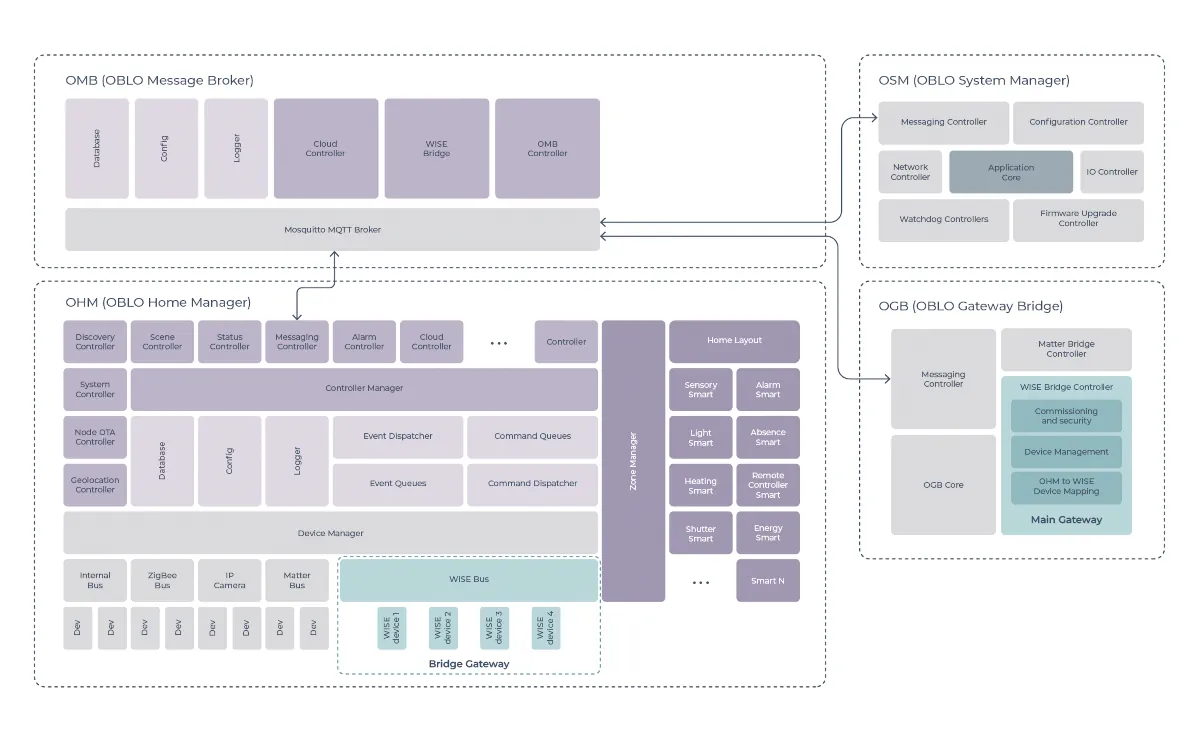
Figure 1. OBLO software stack showing Bridge Gateway and Main Gateway component roles
Communication
Gateway devices are interconnected using the WISE protocol – an IP communication layer that operates over a local area network (LAN) and cloud infrastructure. This ensures reliable communication regardless of whether the gateway devices share the same local network or are located at geographically distant sites.
Two operation modes are supported transparently:
- Local mode – Bridge and Main Gateway reside on the same LAN. Communication is direct, low-latency, and operates independently of internet connectivity. Typically used for multi-floor installation, large buildings or setups with physical obstacles for signal penetration.
- Remote mode – Gateways are on separate networks. The WISE protocol routes traffic through the OBLO IoT Cloud as a relay, enabling deployments across detached buildings or distributed sites. Used in setups where installation buildings are physically dislocated or are segregated in different local networks.
OBLO Gateway Bridge (OGB) – key system component
The core of the gateway linking architecture is the OBLO Gateway Bridge (OGB). It runs on each Bridge Gateway node and acts as an integration layer between the local device management runtime system and the WISE communication channel between gateway devices. The OGB is active on every Bridge Gateway device and enables:
- mapping of local devices
- state synchronization
- communication with the Main Gateway device
- integration of devices into a unified automation system
When a device is added to a Bridge Gateway, its functions and status are automatically forwarded to the Main Gateway, where a digital twin of the device is created in the central system.
For the user, there is no distinction between local and remote devices – all devices participate equally in scenes, automations, and energy management.
Device Representation and Data Flow
The gateway linking architecture enables near real-time data exchange between all nodes in the system. The process works as follows:
- A device connects to a local Bridge Gateway.
- The Bridge Gateway registers the device and its capabilities.
- Information is transmitted to the Main Gateway via the WISE protocol.
- The Main Gateway integrates the device into a unified system model.
- User commands are sent back in the reverse direction to the physical device.
This architecture ensures fast system response, stable communication, centralized management, and a consistent user experience.
Implementation Scenarios
The gateway linking architecture is designed as a flexible solution that supports a wide range of physical environments typical of professional installations. Thanks to its wireless-first design, the system can be deployed without additional cabling in both new buildings and retrofit projects. Below are examples of configurations the system can support:
Scenario 1: Single building with multiple zones
One Main Gateway and one or more Bridge Gateway devices connected via a LAN network, where each covers a separate floor or wing of the building. This is suitable for large apartments, villas, or offices that require radio network segmentation within a unified automation space.
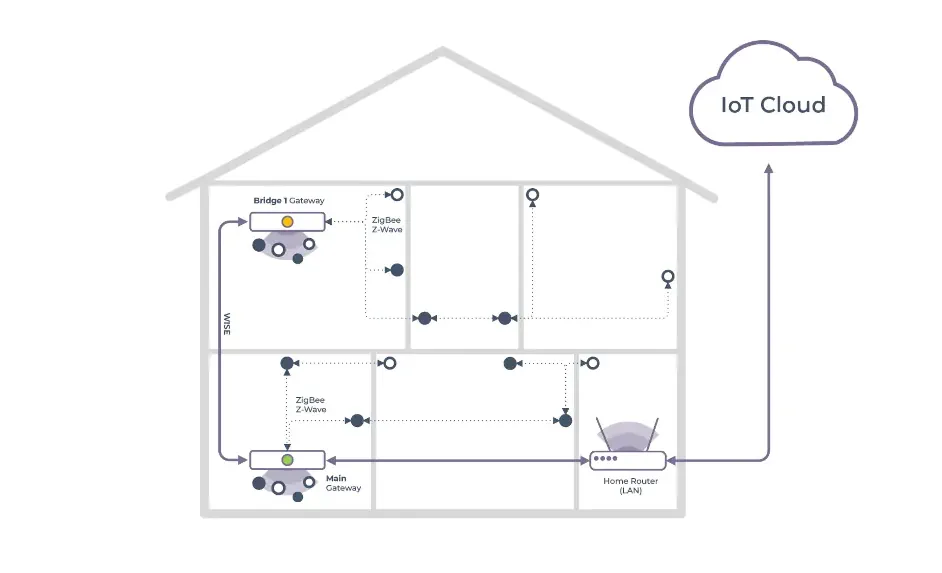
Figure 2. Deployment scenario 1
Scenario 2: Primary building with separate auxiliary buildings
Bridge Gateway devices in auxiliary buildings connect to the Main Gateway via the cloud-routed WISE protocol, enabling unified management without the need for a shared local network.
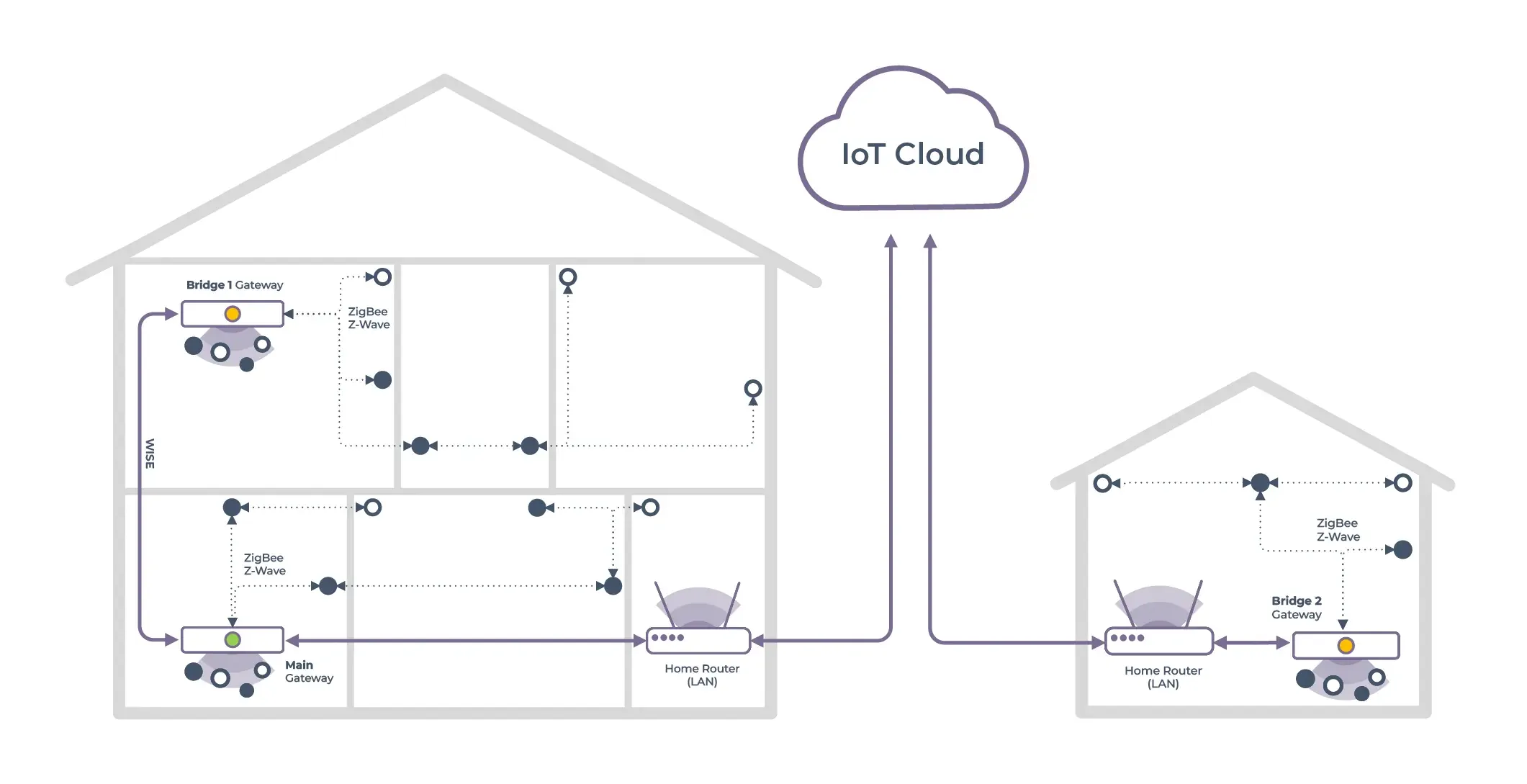
Figure 3. Deployment scenario 2
Scenario 3: Geographically distributed locations
In cases where a shared local network is not possible, all gateway devices independently connect to the OBLO IoT Cloud, where the cloud-routed WISE channel serves as the communication infrastructure.
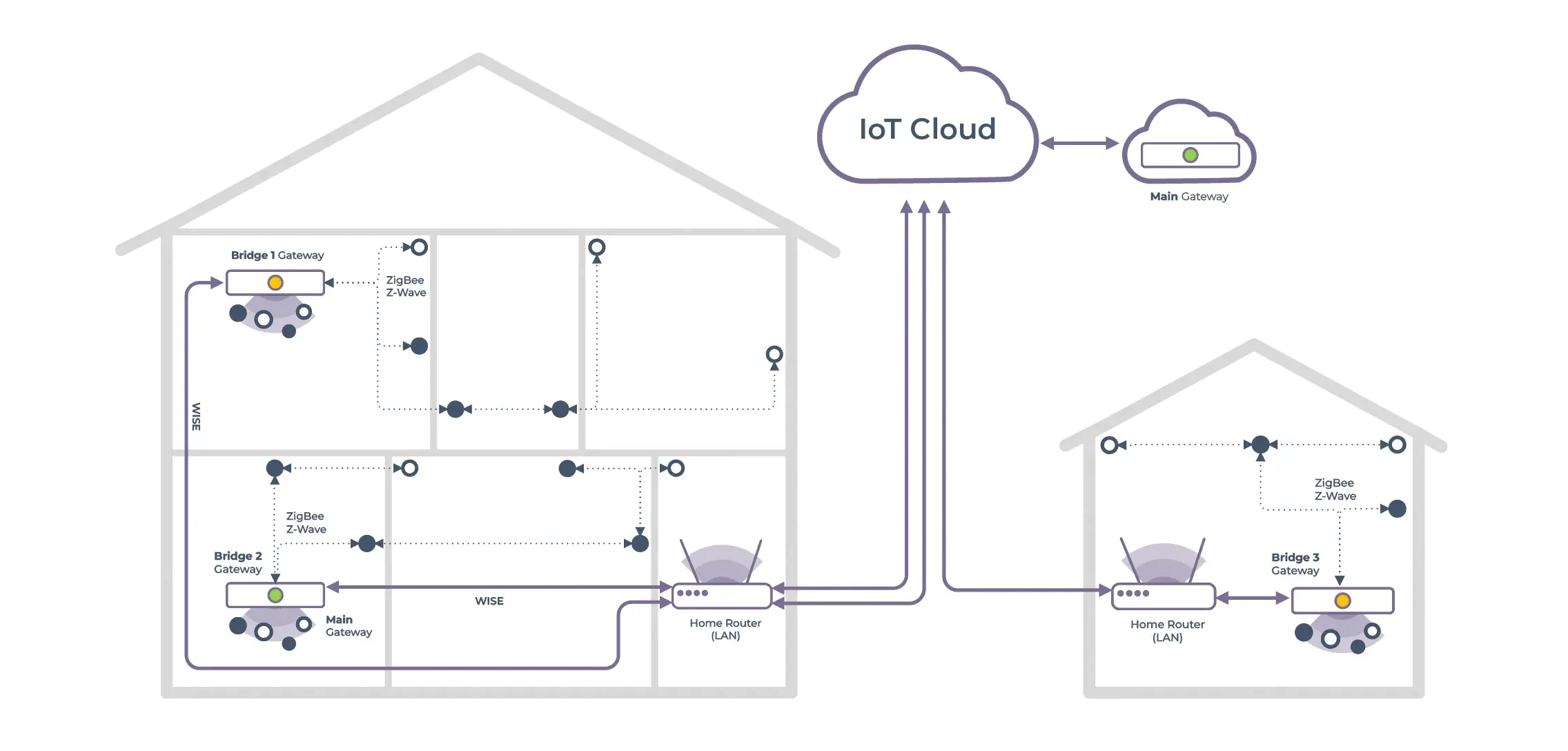
Figure 4. Deployment scenario 3
Hardware Platform
The OBLO Gateway software stack runs on embedded Linux platforms and requires:
- Ethernet or Wi-Fi connectivity
- ZigBee and/or Z-Wave radio modules
Its modular design enables easy integration across different hardware platforms with minimal modifications.
Key Advantages

Radio network segmentation
Each mesh network stays small and stable – no bandwidth saturation or routing bottlenecks regardless of total device count
Unlimited physical range
LAN and cloud-routed WISE paths over concrete, multi-storey structures, and geographic distance between buildings.

Unified automation
All devices visible in a single registry. Scenes, zones, and energy management work cross-gateway without any restrictions.

Unchanged user experience
End users see no difference between locally and remotely connected devices — same interface, same scenes, same logic regardless of installation topology.
Future Development
The gateway linking architecture opens the door for further enhancements, including:
- direct peer-to-peer communication between Bridge Gateway devices,
- local execution of automations between zones,
- dynamic load balancing of mesh networks,
- advanced system telemetry and diagnostics,
- automatic redistribution of devices between gateway nodes.
Conclusion
The gateway linking architecture represents a significant step forward in the development of professional smart building systems. Its distributed architecture enables large and complex environments to operate as a single, unified automation system while preserving centralized control and simplicity of use.
By combining the OBLO Gateway platform and the WISE communication protocol, this architecture enables scalable, reliable, and interoperable deployments designed for modern large-scale installations, ranging from high-end residential buildings to distributed enterprise environments.