

Android systems are increasingly constrained by limited DRAM, making memory efficiency a critical factor for both performance and cost. Unoptimized memory usage across the OS, vendor layers, and applications leads to reduced foreground app headroomand degraded user experience.
This work addresses the challenge through systematic, stack-wide optimization - combining deep profiling with targeted interventions such as kernel tuning, LMKD refinement, service consolidation, and graphics memory reduction.
By optimizing across architecture, system components, and applications - while maintaining full Android compliance - it is possibleto reclaim significant DRAM (often >1 GB) and deliver stable, high-performance devices within constrained hardware environments.
The Memory Squeeze:
A Persistent Threat to Hardware Margins
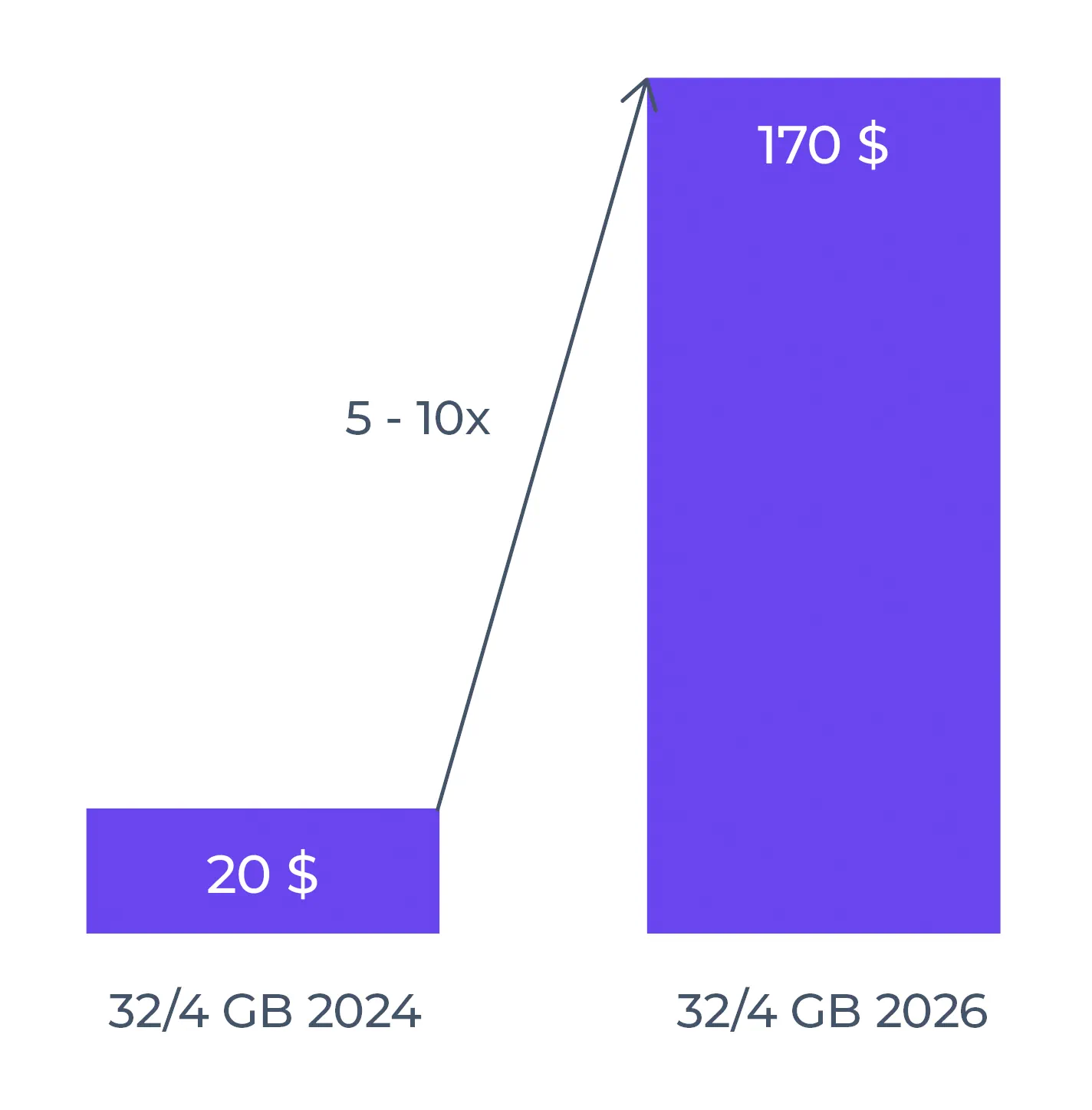
Memory is a structural bottleneck. Price surge and shortage have put it on the critical path.

This is not a temporary supply anomaly. Pressure will persist for at least 2 years.

The industry actively seeks immediate, deployable solutions to defend margins today.
Navigating the DRAM Crisis
Traditional Responses Lead to Flawed Outcomes

Path A: Absorb the Cost
Eating surging DRAM prices directly destroys product margins and severely limits your lifecycle profitability.

Path B: Pass to Customer
Raising the price moves devices out of their target tier. Demand is elastic, so volumes fall and you lose share.

Path C: Hardware Redesign
Forcing a mid-cycle hardware down-spec requires massive Capex, recertification, and critical launch delays.
Our approach is software-only. You are not forced into Path C. We allow ODMs to reclaim memory, allowing you drop to a smaller, cheaper DRAM part at your next planned design point, or use as free headroom on the current board.
RAM Reduction
By optimizing the software footprint of Android OS, SoC SDK and apps we reclaim more than 1GB of resident memory on locked hardware designs.

Scale & Validation
The Jio Tele OS Challenge
RT-RK reduced the RAM footprint of Jio Tele OS, an AOSP-based platform, while keeping a premium user interface. The same per-device saving holds whether you ship hundreds or millions of units.
50%
DRAM Reduction
delivered by RT-RK
2 GB → 1 GB
$20+ per device
≈ $50m total BOM saving
4 Months
to full deployment
from RT-RK Baseline Audit
Our success in memory reduction is achieved by:
Analyzing your specific implementation.
Deploying RT-RK tailored toolset and proven optimization process.
Reducing the ODM Architectural Burden
Google provides baseline AOSP and general platform guidance to improve Android overall,
while RT-RK focuses on optimizing each product individually to address device-specific memory and cost challenges.

Vendor Services

Graphics Buffers

Bespoke Memory settings
Optimization Pillars
Traditional Responses Lead to Flawed Outcomes We Offer a Different Solution to Defend Margins.

Architecture
Consolidating standalone services into unified JAR modules, directly reducing RSS overhead by over 60MB per process. Eliminate unnecessary background processes and employ better orchestration.

OS Baseline
Tuning zRAM/Swap, and optimizing Low Memory Killer (LMKD) for predictable foreground recovery. Optimizing VRAM by reducing surface rendering targets and eliminating oversized textures.

Apps
Restrict available memory and enforce in acceptance testing. Use standard optimized frameworks, optimize heavy flows and tune down non critical features.
Proven Methodology
- Baseline Profiling: deep analysis using tools such as Perfetto, procrank and meminfo to identify RAM pressure sources and optimization candidates
- Runtime Component Mapping: time-based runtime tracing to correlate memory usage with operating states
- Memory Management Tuning: zRAM configuration, LMKD behavior, PSI-based pressure detection, swap behavior and cached-process limits
- Architecture Optimization: removing single-purpose services
- Graphics Memory Optimization: reducing unnecessary buffers and textures
- SystemUI Simplification and App/Launcher Optimization: using standard frameworks, removing unnecessary components and optimizing heavy flows
Measurable Impact
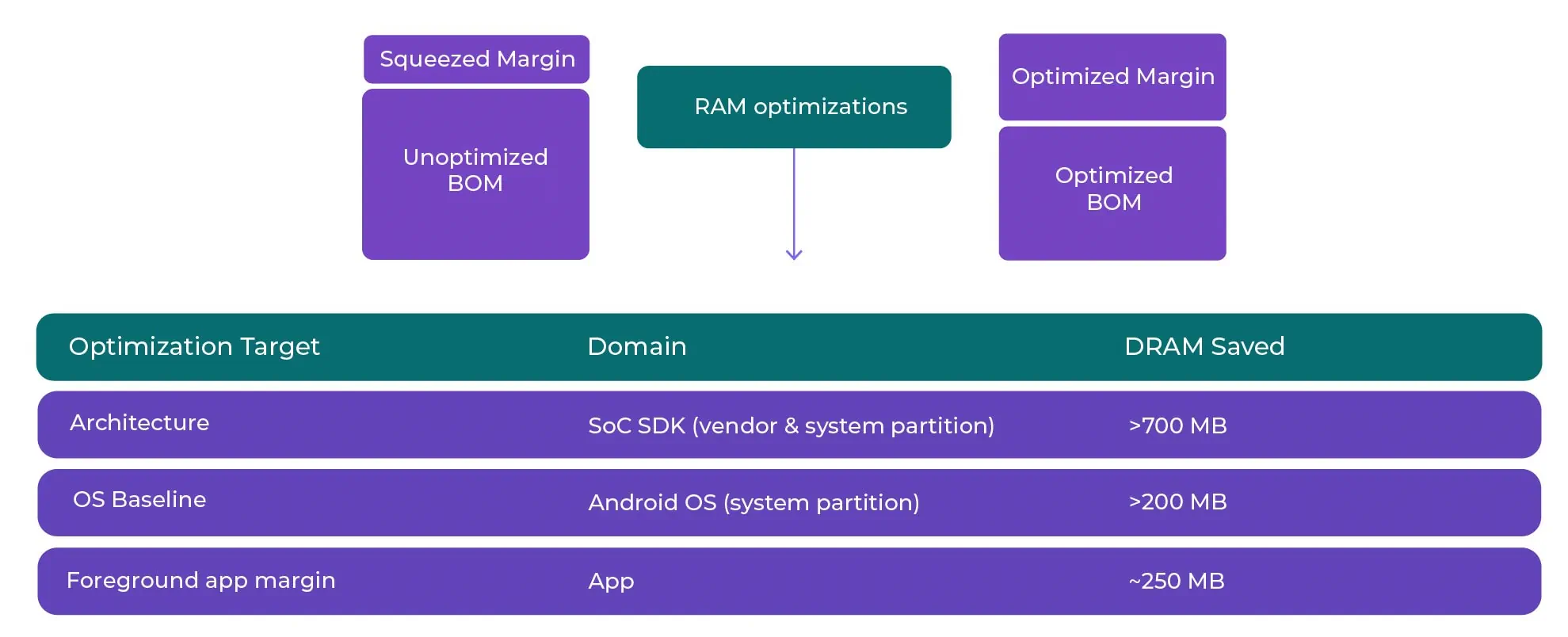
Achieve measurable impact through targeted RAM optimization that transforms unoptimized systems into efficient, cost-effective solutions.
By addressing key layers—from architecture to OS and applications—we deliver significant memory savings while improving margins and overall product performance.
Zero-Compromise Compliance
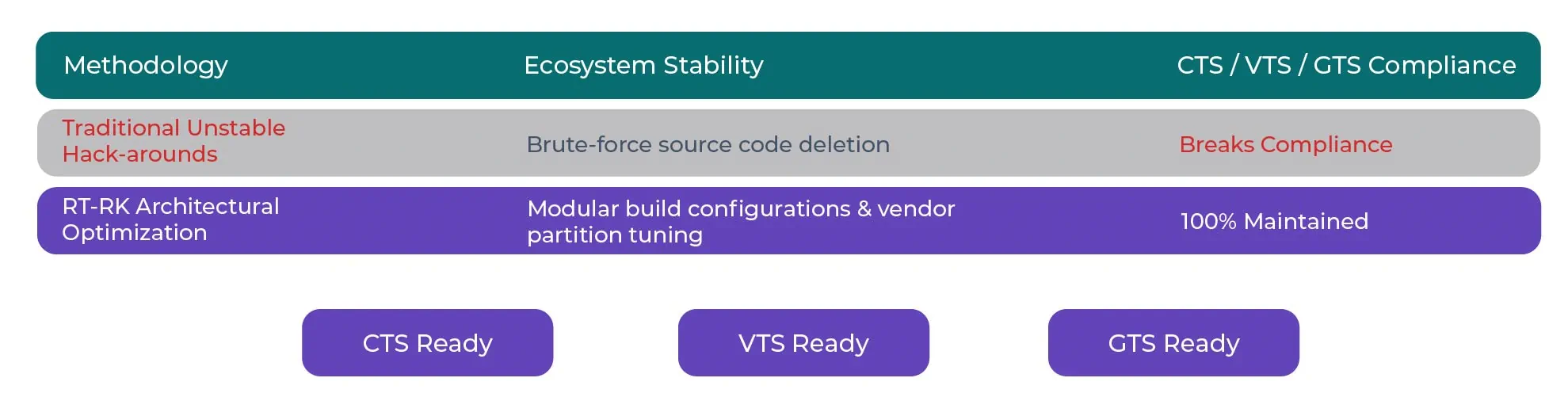
Deep architectural modifications naturally raise concerns regarding official Google certification. Our proven optimization framework is strictly designed within AOSP boundaries.
Engineered for Fixed Lifecycles
The greatest impact is on Android devices that stay in the field for years and run on fixed hardware designs. Lower memory demand protects both new-device BOM and deployed-device life









How We Partner With You

Strategic Audit
Device profiling and bottleneck identification to create a custom optimization roadmap for your specific SoC and OS build.

Targeted Sprints
Focused optimization for specific subsystems where fast gains are possible: Graphics, Media Pipelines, or Memory Leaks.

Full Integration
Complete AOSP platform support, from Kernel tuning through to Product Application stabilization and compliance checking.
Built on trust.
Every engagement runs under NDA from day one. Your source code,
roadmaps and benchmark results stay confidential and remain entirely yours.
Deployment Architecture: 90 Days to Viability
Baseline & Audit
Deep profiling of SoC and unoptimized AOSP build using Perfetto & procrank. Identification of major memory sinks.
Surgical Optimization
Application of optimized architecture. Kernel tuning, LMKD re-engineering and SystemServer stripping.
Stabilization
Final integration testing, CTS compliance verification, and firmware image delivery with metrics.
Scale & Deploy
Rollout optimized OS to hardware fleets, achieving target margin defense and extended device lifecycle.
Automated regression testing runs throughout. Every build is re-checked against CTS/VTS/GTS and the agreed memory targets, so no optimization can quietly regress.

BOM Reduction. Extended Lifecycle. Efficiency.
Trusted by the Ecosystem Leaders














White paper
What’s Inside?
- How to profile where RAM really goes, across boot, idle, navigation, playback and long-run use
- Which framework services, background processes and graphics buffers you can safely trim, and which platform limits you cannot
- How to tune Android memory management (zRAM, LMKD, PSI) so the device stays stable under pressure
- A clear optimization sequence and decision logic for tracing memory pressure back to its root cause
- An effort-risk-impact matrix for prioritizing changes, plus RT-RK engagement models for getting the work delivered