
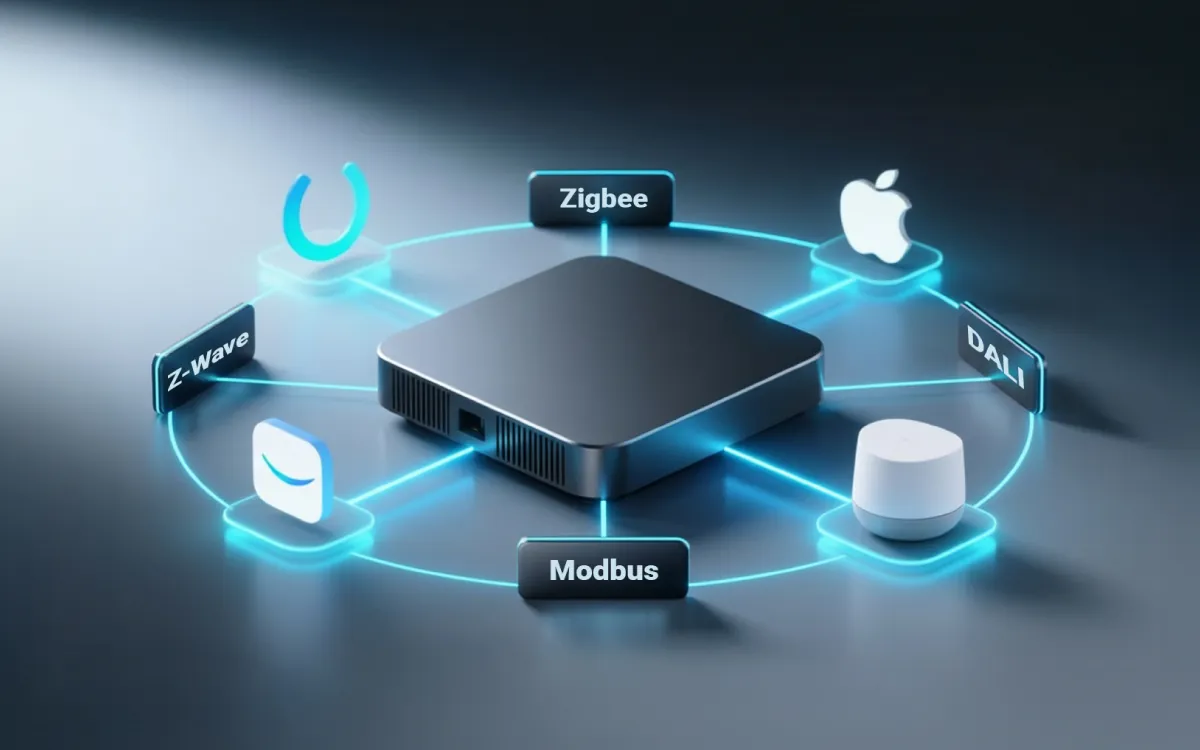
The rapid adoption of the Matter standard is transforming the smart home and industrial automation landscape by providing a unified, IP-based communication layer. However, countless devices still rely on legacy non-IP protocols such as Zigbee, Z-Wave, Modbus, KNX, and DALI. RT-RK’s Matter Bridge solution addresses this challenge, enabling these devices to operate natively within the Matter ecosystem and be controlled through major smart home platforms like Apple HomePod, Google Nest Hub, and Amazon Alexa.
This case study outlines the design, integration, and benefits of the Matter Bridge, highlighting its architecture, device-mapping strategies, and deployment flexibility.
Matter Bridge Support in the OBLO Gateway
Overview
RT-RK developed a Matter Bridge application integrated into the OBLO Gateway software stack, enabling non-Matter devices to be represented and controlled within a Matter network.
A successful deployment demonstrated seamless integration with Google Home and Apple Home, enhancing the user experience through unified voice control and automation. Further customization is possible as the OBLO Gateway supports multiple communication protocols, for bridging of industrial and legacy devices into Matter.
Introduction
The Matter standard simplifies interoperability, but a significant portion of existing automation infrastructure relies on non-IP protocols. The Matter Bridge provides a seamless integration layer, converting legacy devices into Matter-compliant endpoints.
Key benefits include:
- Extending the lifecycle of existing devices
- Unified control through popular Matter controllers
- Accelerated convergence of smart technologies under a global standard
System Architecture
The Matter Bridge is built on the OBLO Gateway framework with the Matter SDK integrated into the OBLO Gateway Bridge (OGB) application. Four core applications work together, with Oblo Home Manager (OHM) and OGB forming the central components responsible for bridging legacy devices.

Figure 1. Matter bridge architecture
Oblo Home Manager (OHM) manages communication with devices over Zigbee, Z-Wave, DALI, Modbus, and other protocols. Each protocol has a dedicated communication bus responsible for:
- Device discovery
- Network management
- Command dispatching
- State synchronization
OHM normalizes device communication into a unified interaction data model, allowing higher-level components to interact with devices regardless of protocol specifics.
Oblo Gateway Bridge (OGB) integrates the Matter SDK and exposes bridged devices into the Matter ecosystem. Each legacy device is virtually translated into a Matter-compliant endpoint, preserving its functionality within the Matter network.
Key responsibilities of OGB:
- Matter Bridge commissioning to a Matter network
- Creation of a Matter device interaction data model (bridge endpoints)
- Mapping legacy device functionalities to Matter clusters
Matter bridge commissioning
Commissioning allows devices to join a Matter Fabric. OGB supplies the required onboarding information via API, enabling smart home client apps to retrieve and display QR codes and manual pairing codes.
Stages of commissioning:
- Device Discovery – Advertised via DNS-SD on the IP network
- PASE Security Setup – Preliminary node configuration, validates DAC certificates, manages NOC installation
- CASE Security Setup – Establishes secure operational connections with the Matter Controller
Creating matter bridge device models
Bridged devices are represented in Matter-compliant data structures. Multi-capability devices, such as a Zigbee multisensor reporting temperature and humidity, are modeled as composite Matter devices:
- Endpoint 1: Temperature Sensor
- Endpoint 2: Humidity Sensor
This preserves all functionality and ensures full accessibility from Matter controllers.
Mapping legacy protocols to matter clusters
| Legacy Cluster | Matter Cluster |
|---|---|
| Zigbee 0x0402 Temperature Measurement | Zigbee 0x0402 Temperature Measurement |
| Zigbee 0x0405 Humidity Measurement | Matter Humidity Sensor |
| Legacy Cluster | Matter Cluster |
| Zigbee 0x0006 On/Off | Zigbee 0x0006 On/Off |
| Zigbee 0x0008 Level Control Matter Level Control | Matter Level Control |
Table 1. Translation of legacy device clusters into Matter clusters
Changes in legacy networks propagate to Matter endpoints and vice versa, ensuring synchronized control across ecosystems.
Unified user experience
Once bridged, devices are accessible via any Matter-compliant controller:
- Apple HomePod / Home app
- Google Nest Hub / Home app
- Amazon Alexa / Echo devices
- Other certified Matter controllers

Figure 2: Matter bridge block diagram
This integration creates a single, secure, interoperable IP framework, simplifying user interaction and automation management across the entire environment
Integration with third-party gateways
OBLO Gateway’s modular architecture allows Matter Bridge deployment on third-party hardware across Linux and Android platforms. Its protocol abstraction layers enable operation on different hardware without redesign.
Platform compatibility:
- ARM-based Linux or Android SoCs
- Wi-Fi/Ethernet IP transport
- Optional Zigbee, Z-Wave, Thread radios, or serial interfaces
This flexibility allows deployment on existing commercial hubs, set-top boxes, or newly developed bridge hardware.
Integration model:
- Protocol Bus modules for each non-IP technology
- OBLO Home Management for unified device modeling
- OBLO Gateway Bridge for endpoint creation, cluster mapping, and command translation
Benefits:
- Rapid Matter Bridge capability deployment
- Reuse of existing hardware
- Unified representation of multiple legacy ecosystems
- Compatibility with all Matter controllers
Conclusion
The RT-RK Matter Bridge is a future-proof solution that unifies legacy automation protocols under the Matter standard. By enabling non-IP devices to operate seamlessly in modern IP-based ecosystems, it:
- Extends infrastructure lifecycle
- Reduces development complexity
- Simplifies certification
- Provides unified user experience
For manufacturers and system integrators, this approach opens access to a global ecosystem of interoperable devices and services, creating a secure, user-centric, and unified smart home and industrial automation environment.