
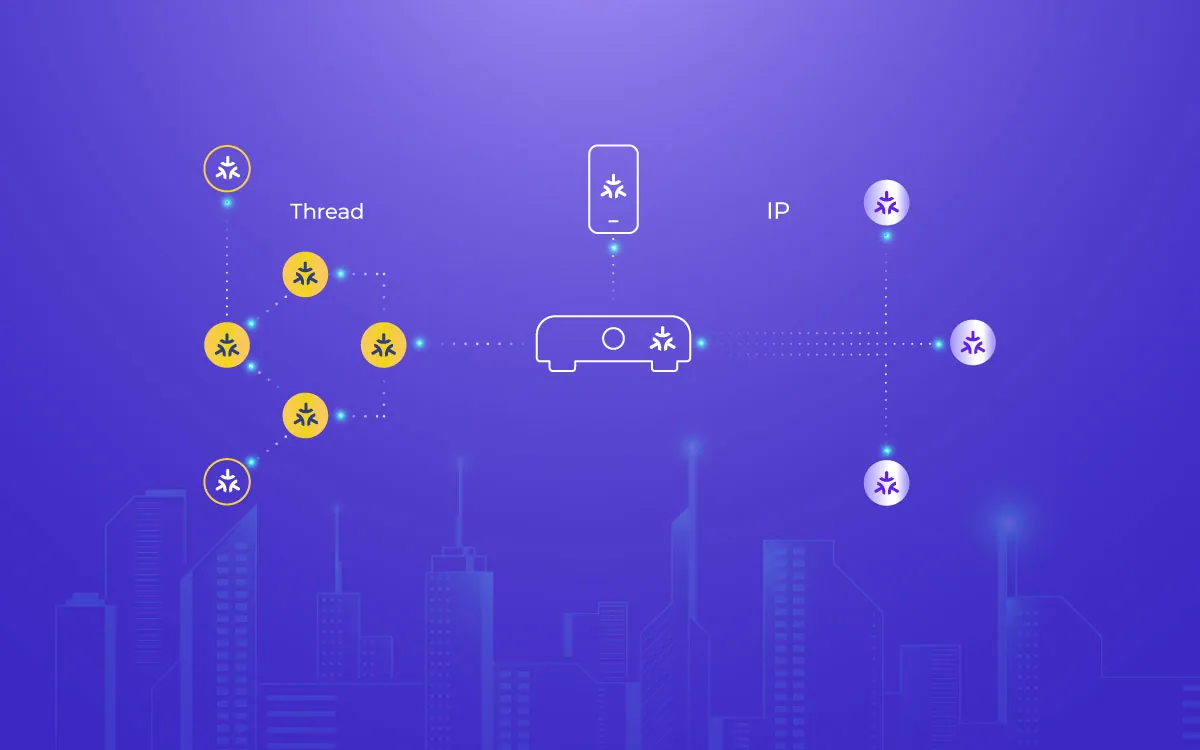
This case study describes the concepts and architectural decisions behind enabling full Matter Controller functionality and OpenThread Border Router services in the OBLO Gateway, operated by one of the largest telecom operators in the world. The goal of the implementation was to add native Matter and Thread support while preserving interoperability with existing Zigbee, Z-Wave, Philips Hue and Modbus installations.
The work delivers a scalable foundation for future IoT systems that must manage both IP-based devices and low-power Thread nodes inside a unified model—aligning OBLO with modern controllers such as Apple Home, Google Home, and Amazon Alexa.
Why this matters
Smart-home platforms have historically operated across multiple, mutually incompatible protocols, increasing deployment complexity and creating fragmented user experiences. With the industry shifting toward IP-native connectivity and Thread-based low-power devices, telecom operators are introducing Matter as the new interoperability standard.
By integrating Matter Controller and OTBR directly within the gateway, this solution:
- removes the need for external Matter hubs
- enables direct Thread commissioning
- preserves Zigbee/Z-Wave investments
- supports multi-admin models (Apple / Google / OBLO in parallel)
- and simplifies large-scale operator deployments
This results in lower installation cost, faster onboarding, and unified smart-home operation under a single carrier-grade platform.
Overview
RT-RK expanded the OBLO Smart Home platform by adding native Matter Controller capabilities and OpenThread Border Router support, transforming the gateway into a next-generation, interoperable smart-home controller. The integration enables Matter-compliant devices to be controlled within OBLO while maintaining existing communication technologies already deployed in customer homes.
This extension introduces a new protocol layer inside OBLO, maintains consistent system behavior across heterogeneous devices, and significantly enhances the end-user and deployment experience—without replacing the hardware or existing automation logic already installed in the field.
Introduction
For more than a decade, smart-home systems have depended on a mix of proprietary technologies, limiting interoperability and creating complex deployment requirements for telecom operators and system integrators. Matter introduces a standardized, IP-based approach that addresses these limitations and allows cross-vendor interoperability with secure, consistent behavior.
As Thread becomes the preferred low-power communication mechanism for IP-native devices, modern platforms must combine IP networks and Thread mesh operation within a unified architecture. In the Matter ecosystem, this requires two components:
- the Matter Controller, managing secure Fabric and device interaction, and
- the OTBR, enabling direct connectivity with Thread devices
Together, they provide a complete, vendor-neutral interoperability model aligned with Apple, Google, and Amazon ecosystems.
System architecture
The system architecture of the OBLO Gateway with integrated Matter support builds on the existing layered multiprotocol framework, extending it to support mechanisms for Matter communication and Thread networking.
The system keeps its established separation between device-interaction data models, protocol implementations, and system-level services, allowing new capabilities to be introduced without modifying the existing software architecture. Within this structure, two key components form the foundation of Matter functionality on OBLO Gateway: the Matter Controller, responsible for managing the logical and security aspects of Matter devices, and the OTBR, which enables direct connectivity with Thread-based Matter nodes.
By combining these elements within a unified gateway design, the system can support Wi-Fi, Ethernet and low-power Thread Matter devices through a single architecture, eliminating the need for external hubs and ensuring consistent behaviour across all supported technologies.
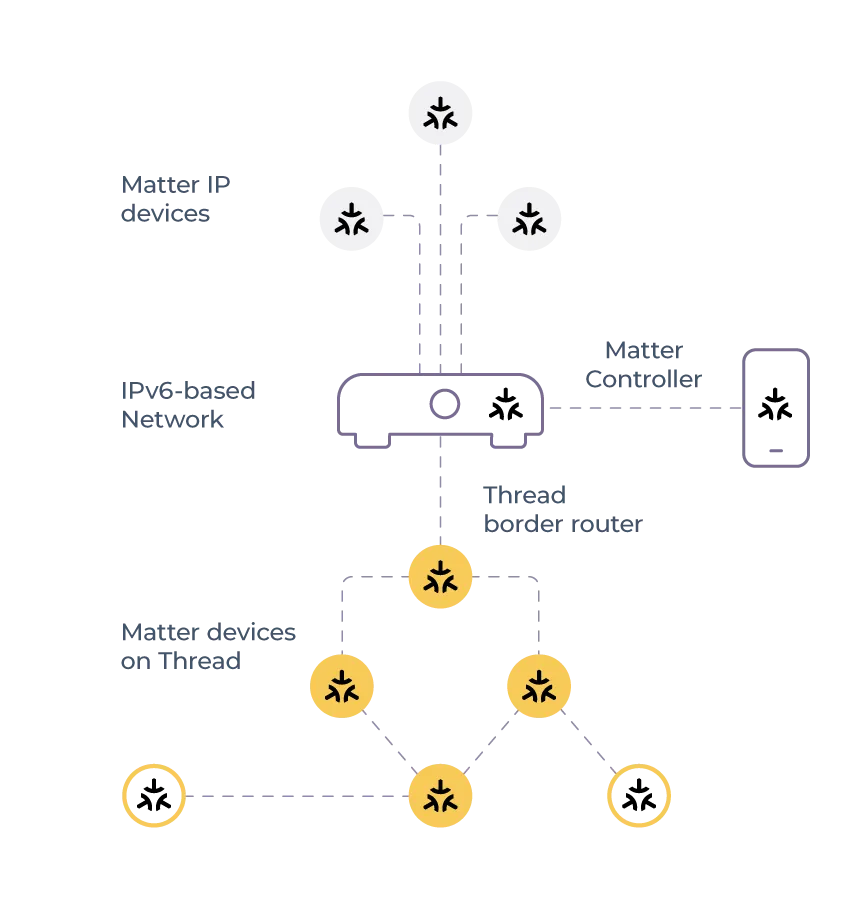
Figure 1. High-Level Architecture
1.1 Matter controller
The introduction of Matter Controller functionality elevates the OBLO smart-home gateway into a platform capable of natively managing and coordinating a new generation of Matter interoperable devices. The system broadens its compatibility, allowing a wider spectrum of smart-home products to be integrated under a unified operational model. This integration allows users to easily add Matter-compatible devices to the OBLO smart-home system, enabling advanced automation through OBLO’s rule engine and data-driven services.
OBLO Home Manager (OHM) serves as the central runtime application responsible for device interactions within the gateway. To ensure an integrated and consistent design, the Matter Controller follows the established architectural pattern and utilizes the mechanisms and infrastructure already defined for other protocols in the gateway. This is achieved by implementing Matter Controller support as a new communication bus within the OHM application that relies on the Matter (CHIP) SDK.
By adopting this approach, the gateway can present Matter devices alongside ZigBee, Z-Wave, or other IP-based devices, robust operation across all existing mechanisms.
Matter controller responsibilities:
- Matter network management – Fabric management and administration.
- Device commissioning – Adding devices to the Fabric.
- Device management – Device access control and lifecycle management
- Device control and monitoring – Abstracting Matter devices in OBLO system, mapping device functionalities to OBLO services, subscribing to device events, device group control.
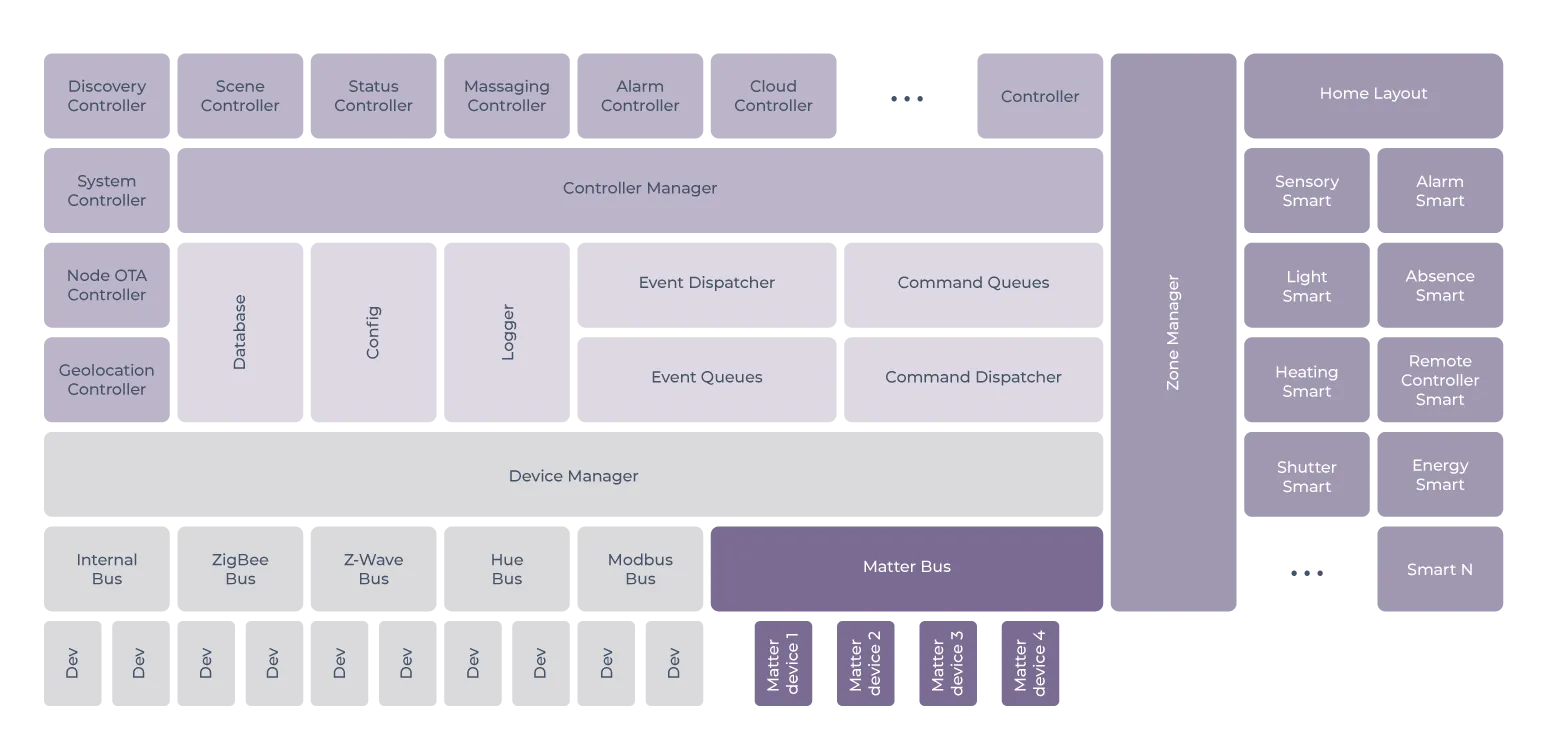
Figure 2. Matter controller integration in OHM
Commissioning workflow and fabric management
The Matter controller participates in all gateway-side stages of the commissioning workflow, working in coordination with the client application. The mobile application performs device discovery and the PASE onboarding phase, while the gateway completes operational discovery and establishes a secure session with the device through CASE. As part of this process, the controller generates and stores the operational credentials (NOC) and uses the Matter Bus to bring the device into the local Fabric once it is provisioned onto the network. Fabric is specific to OBLO Gateway.
After a device successfully joins the Fabric, the controller maintains its operational credentials and manages secure communication throughout the device lifecycle. Devices may be removed either through the application or by performing a factory reset, after which the gateway removes all associated state.
Matter additionally enables a multi-admin model, in which the same physical device can belong to multiple Fabrics and be controlled by several independent controllers. This means that a device previously commissioned to another controller, such as Google Nest Hub, Apple HomePod, or any third-party Matter controller, can also be added to the OBLO Gateway without requiring removal from the original system and enabling fully parallel control across ecosystems. Effectively it enables users to do a professional smart home installation while using voice services from Google and Apple.
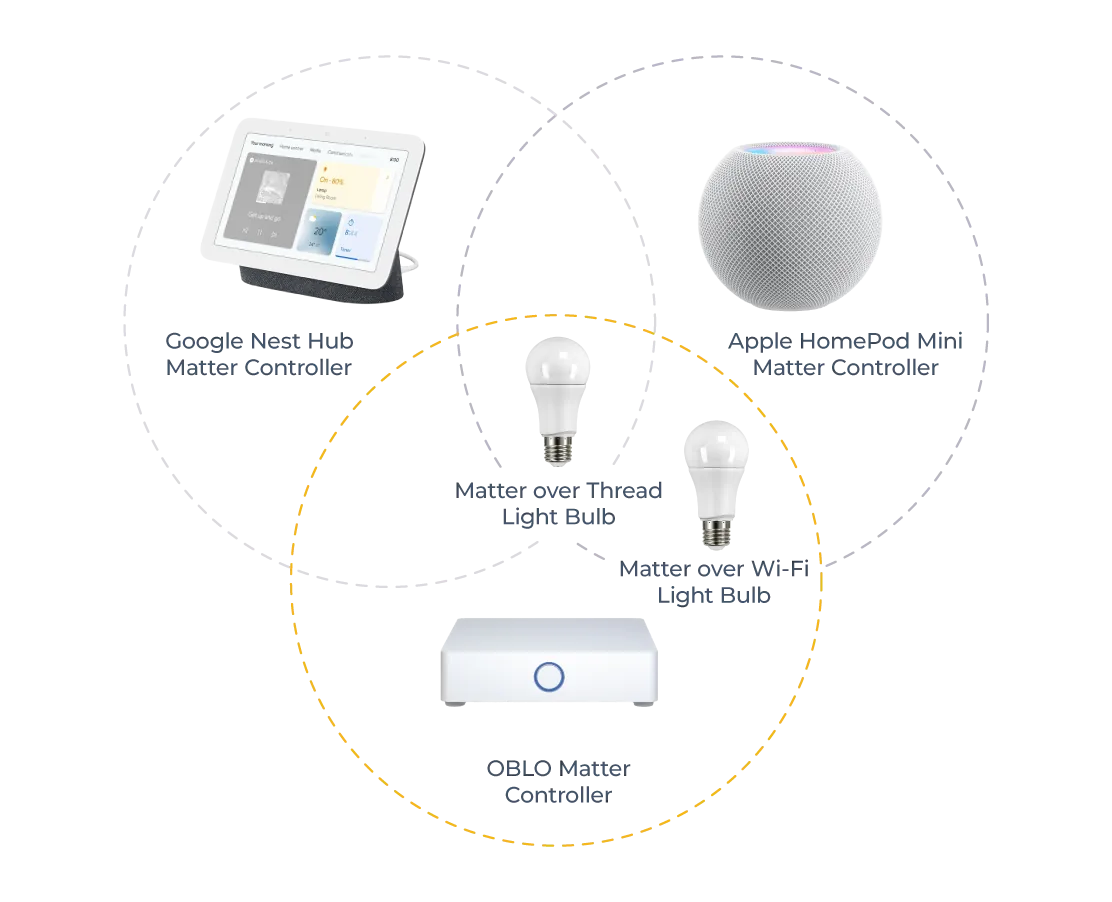
Figure 3. Multi-admin model
To preserve the interoperability goals of the Matter standard, the controller provides generic support for all device types based purely on their data model. Instead of relying on predefined profiles, the Matter Bus discovers endpoints, clusters and capabilities dynamically during commissioning, including manufacturer-specific features when supported by the implementation.
Creation of Matter Controller device interaction data model
The Matter Controller inside the OBLO Gateway relies on the Matter CHIP SDK to construct an internal interaction data model that accurately represents every device commissioned into the system. When a device joins the Matter fabric, it appears as a node, which is the logical representation of the device within the network. Each node is uniquely identifiable and serves as the top-level entity under which the device’s functional structure is organized.
During commissioning, the controller queries the node for its full structural description, retrieving its list of endpoints and the clusters attached to each endpoint. Endpoints represent functional components of the device. For example, a lighting device may provide an endpoint with an On/Off cluster for switching, a Level Control cluster for dimming, or a Colour Control cluster for colour adjustment. Each cluster is defined by its specification, describing the attributes, events, commands, and the behavioural rules that determines how these elements interact within the OBLO device data model. When the user performs an action or an automation rule triggers a command, the controller translates the request into a Matter-compliant operation and targets the appropriate endpoint and cluster defined in the model.
1.2 OpenThread Border Router - OTBR
Thread Border Router provides seamless connectivity between a Thread mesh network and external IP networks. On the OBLO Gateway, the OTBR component forwards IPv6 traffic, enables cross-network service discovery, and allows Thread-based Matter devices to be commissioned, addressed and controlled by the Matter Controller.
Through mDNS on Wi-Fi/Ethernet, and SRP within the Thread network, the border router supports full bidirectional service visibility, ensuring that device capabilities and operational data are reliably exchanged across network boundaries. With support for Thread-over-Infrastructure, the OTBR can merge multiple Thread partitions over IP links, maintaining a unified mesh even when the wireless network is physically segmented and thereby improving coverage and robustness.
The OBLO Gateway manages its own Thread network. During the initial setup, the gateway creates the Thread network by selecting the optimal channel, generating a unique PAN ID, and creating a secure network key, which is stored in a protected location on the device. This network key is then shared with the client application during the commissioning process through the already established and secure communication mechanisms between the gateway and the client.
Integrating OTBR functionality directly on the OBLO Gateway enables Matter-over-Thread devices to operate in system without requiring additional hubs or bridges. During commissioning phase, the OTBR allows external commissioners, client application to authenticate and securely attach new Thread devices using standardized onboarding procedures. State updates originating from Thread nodes are routed through the OTBR into the Matter SDK and subsequently into OHM’s unified device model, where they become part of automations, cloud synchronization processes and higher-level system logic.
CPCD Integration and dual-mode Mg24 radio
The gateway relies on a Silicon Labs MG24 multiprotocol radio module to support Thread networking on embedded hardware. In this configuration, the MG24 operates in RCP (Radio Co-Processor) mode, where low-level radio processing is executed on the module itself, while higher-level Thread functions run inside the OTBR service on the host system.
Communication between the host and the MG24 radio is handled by the Co-Processor Communication Daemon (CPCd), which provides a reliable, framed communication channel and abstracts the underlying transport details. This allows the Thread stack on the gateway to interact with the radio in a stable and predictable way during commissioning, operation, and network maintenance.
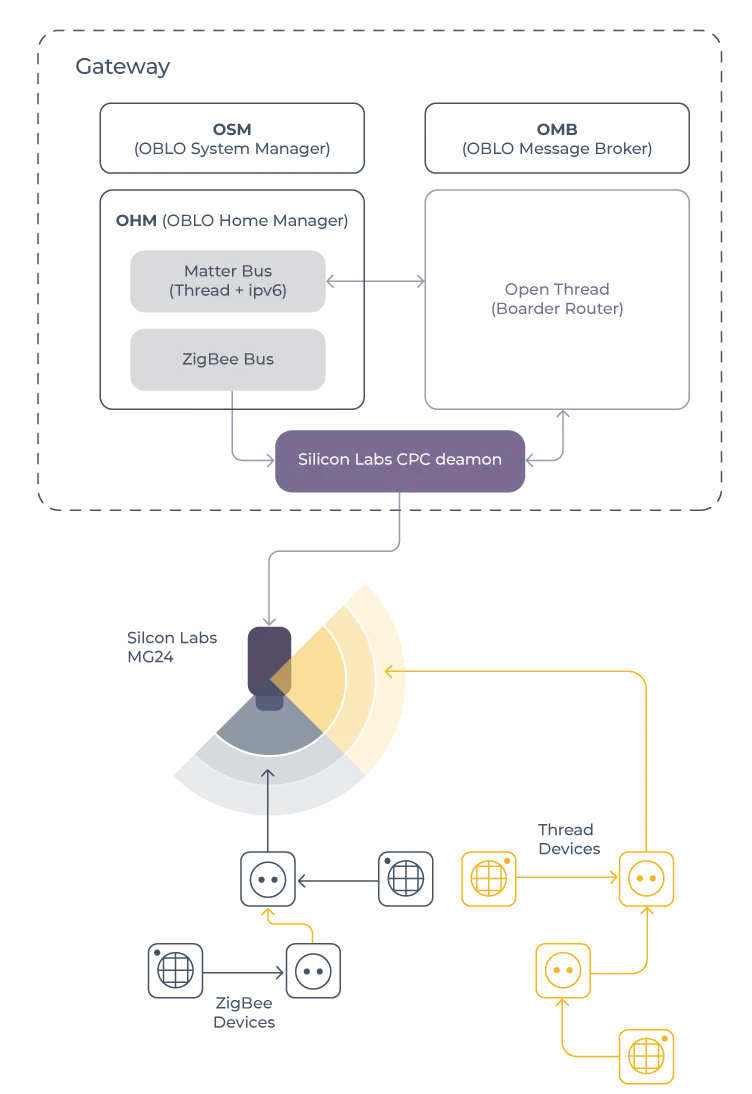
Figure 4. Gateway MG24 dual-mode Zigbee/Thread architecture
In addition to Thread, the MG24 also supports Zigbee through NCP, enabling both technologies to coexist on the same hardware. Zigbee continues to serve existing device ecosystems through the OBLO Home Manager, while Thread is used for Matter-native devices. Consolidating both protocols on a single radio module simplifies the hardware architecture and enables the gateway to act simultaneously as a Zigbee coordinator and a Thread border router.
By combining CPCd, the OTBR runtime, and the MG24 radio module, the gateway becomes a fully capable Thread infrastructure node while retaining compatibility with existing Zigbee-based systems. This integrated approach establishes a foundation for secure IPv6 connectivity, reliable network formation, and seamless Matter commissioning within a unified smart-home architecture.
Note that the software can also operate with two dedicated MG24 modules—one for Zigbee and the other for the Thread network. While this configuration may offer certain performance advantages, it is a less cost-effective solution.
1.3 Matter controller and OTBR integration in 3rd party gateways
The OBLO Gateway software stack can be integrated into various 3rd-party gateway platforms to provide full Matter Controller functionality on both Linux and Android systems. Its modular architecture and service-oriented abstraction layers allow the controller to operate on different hardware configurations without requiring redesign of the underlying device.
Platform compatibility
The solution runs on lightweight embedded systems using:
- ARM-based Linux or Android SoCs
- Wi-Fi/Ethernet for IP transport
- IEEE 802.15.4 radio (e.g., Silicon Labs MG24) for Thread/Zigbee support
This allows integration into third-party gateways, home routers, set-top boxes or new IoT controller hardware without requiring changes to the underlying device architecture.
Benefits
Integrating the OBLO Matter Controller and OTBR into 3rd-party gateways provides several key advantages:
- Unified device representation – Matter endpoints, attributes and events are mapped into the OBLO model, enabling consistent interaction across the entire gateway ecosystem.
- Seamless multi-protocol operation – Thread support via OTBR/CPCd allows simultaneous management of Thread Matter devices.
- Reduced complexity – Thread and Zigbee communication can be supported on a single multiprotocol radio (e.g., MG24).
- Future-proof architecture – new Matter clusters, device types and features can be adopted with minimal changes due to the modular integration structure.
- Industry-aligned controller behaviour - On par with Apple Home, Google Home and Amazon Alexa ecosystems.
Conclusion
The integration of Matter Controller functionality and OpenThread Border Router support enables the OBLO Gateway to operate as a fully standards-aligned smart-home system, while maintaining its long-established role as a multiprotocol automation controller. Beyond Matter and Thread, the gateway continues to provide seamless interoperability with Zigbee, Z-Wave, Philips Hue, Modbus and other device ecosystems, unifying them under a consistent operational model managed by OBLO Home Manager.
By combining secure Matter fabric management, device modelling, and Thread connectivity through the MG24 dual-mode radio and OTBR runtime, the gateway ensures consistent behaviour across all supported communication technologies. It provides a unified operational model for both IP-based Wi-Fi devices and low-power Thread mesh nodes within a single, integrated system.
The modular architecture further enables straightforward adoption on third-party gateway platforms, allowing manufacturers to incorporate introduced Matter capabilities. This positions the OBLO Gateway on the same technological level as leading industry ecosystems, while maintaining backward compatibility and offering a future-proof foundation for large-scale interoperable smart-home deployments.