
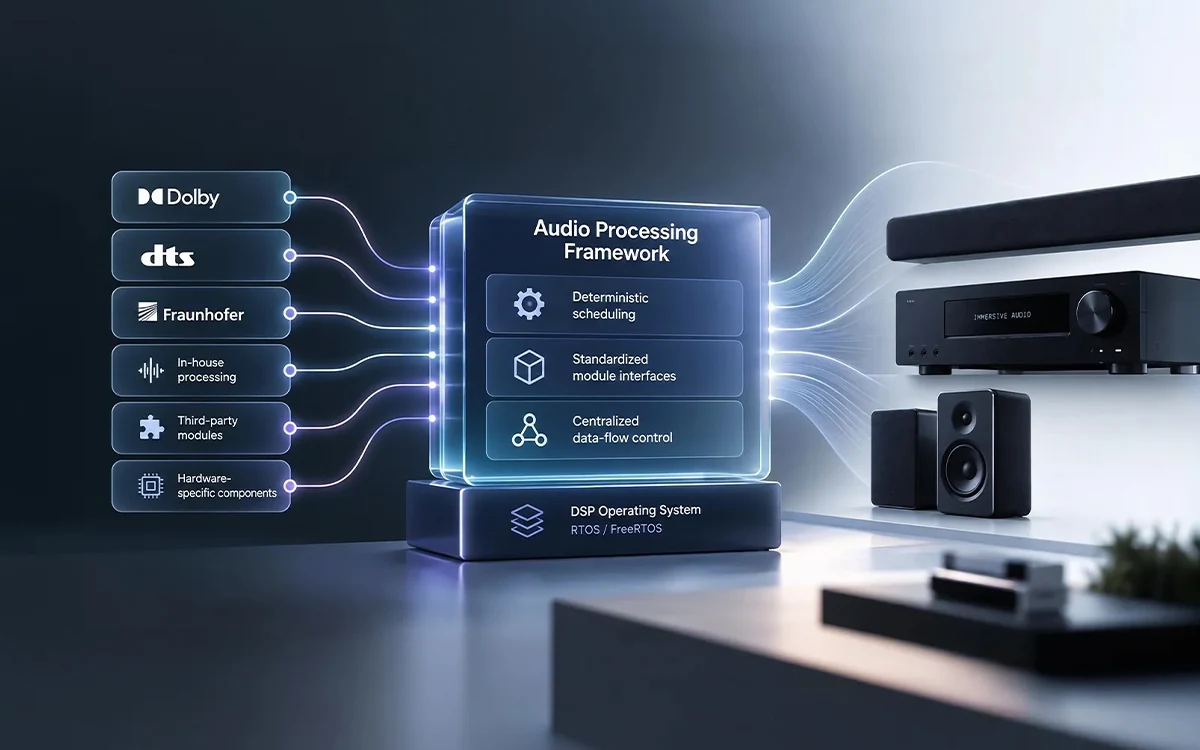
Developing a modern audio device - whether a soundbar, AV receiver, or embedded audio system - goes far beyond integrating individual technologies. It requires turning a collection of independently developed components into a coherent, shippable product.
Modern audio pipelines combine licensed technologies such as Dolby, DTS, and Fraunhofer with in-house processing, third-party modules, and hardware-specific components. Each comes with its own assumptions about execution, control, and data flow. Without a structured environment, integration becomes fragile, difficult to scale, and challenging to standardize.
The gap between a working component and a production-ready system is not incremental - it is architectural.
Why Structure Becomes Necessary
As audio systems evolve, complexity increases not because of any individual technology, but because of the interactions between multiple independently developed technologies operating within the same product.
Decoders, renderers, post-processing engines, and vendor-specific components each carry their own execution models, control assumptions, and resource requirements.
In simple systems, these interactions can often be managed through direct integration. As complexity grows, however, integration alone becomes insufficient. Maintaining predictable behavior, consistent resource utilization, and scalable product development requires a common operating model for coordinating how technologies execute, communicate, and share system resources.
This becomes particularly important as platforms evolve across multiple product variants, feature sets, and technology combinations. Project-specific integration may be sufficient for a single product, but becomes increasingly difficult to maintain, reuse, and scale across an entire product portfolio.
In complex production programs, growing technology count, product variation, and long-term platform evolution places increasing pressure on integration and maintenance efforts.
The challenge is therefore not simply integration, but controllability.
A system cannot remain predictable if each component introduces its own model for execution, data flow, and resource management. Establishing that control requires a framework capable of transforming a collection of processing technologies into a coherent, scalable system.
The Challenge: Complexity Without Structure
The complexity of modern audio systems is not rooted in individual technologies – it arises from how they interact within a constrained system.
Typical symptoms include:
Late-Stage Integration Failures - Issues appear during system integration rather than module development, making them costly and difficult to resolve.
Format Transition Artifacts - Switching between formats, such as Dolby and DTS, can introduce audible glitches or delays.
Repeated Effort Across Product Variants - New SKUs require re-integration instead of enabling reuse of existing processing components.
Limited System Visibility - Debugging can require invasive instrumentation or deep domain expertise.
At the same time, DSP-based platforms impose strict constraints:
- Limited memory and processing resources
- Real-time execution guarantees
- Tight latency requirements
While the behavior of individual components may be well understood, managing them as a system remains the central challenge.
The Framework Approach
To address this challenge, we developed an audio processing framework that introduces structure across the software stack, shaped by years of practical integration experience across complex DSP-based audio systems.
The objective is not the framework itself, but the establishment of a predictable and controllable execution environment in which independently developed audio technologies can operate as part of a single system.
The framework acts as a standardized layer between:
- The DSP execution environment - RTOS / FreeRTOS-based systems
- Audio processing modules - vendor, third-party, and in-house
It establishes:
- A unified interface model for all audio modules
- A controlled execution and scheduling system
- A standardized data-flow and resource-management architecture
At its core, the framework integrates closely with the underlying DSP operating system, leveraging OS-provided services such as scheduling, memory management, and timing guarantees through a dedicated OS integration layer.
The Audio Framework therefore acts as a control and execution layer between low-level system services and high-level processing modules, as illustrated below.
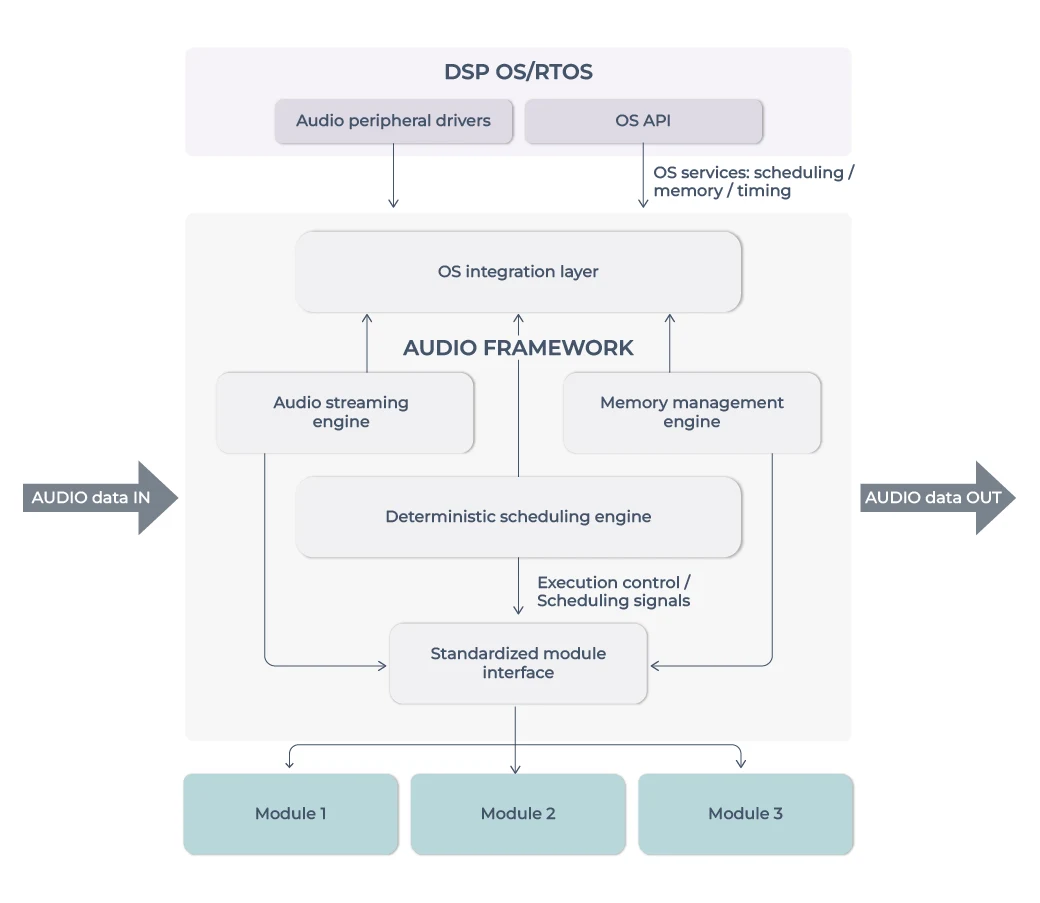
Figure 1: The Audio Framework positioned as a deterministic execution layer between the DSP operating system and pluggable audio processing modules.
The framework transforms OS-level services into a controlled environment by unifying:
- Execution control through scheduling
- Data propagation through streaming
- Resource management through memory
This transforms audio pipeline development from an ad-hoc integration effort into a repeatable engineering process.
More importantly, system integration becomes a reusable engineering capability rather than a recurring project activity. Instead of recreating integration solutions for each product, teams can build upon a common execution and control model that scales across platforms, product variants, and future technology generations.
Execution Model: Deterministic by Design
At the core of the framework is a deliberately simple but powerful concept: deterministic execution.
The deterministic scheduling engine acts as the central control unit, coordinating execution across processing modules and enforcing a strict, predictable execution order.
Audio data propagation is handled by a dedicated audio streaming engine responsible for buffering, inter-module data transfer, and interaction with underlying audio I/O drivers.
Complementing this, the memory manager ensures controlled allocation and reuse of system resources, aligning memory usage with real-time processing constraints.
Together, these components define three fundamental aspects of the framework:
- Execution control - scheduling
- Data propagation - streaming
- Resource management - memory
Key Architectural Concepts
Standardized Module Interface
All audio components - regardless of origin - conform to a common interface model.
This includes:
- Buffer-based input/output definitions
- Control and configuration APIs
- Lifecycle management: init, start, stop, and reset
As a result:
- Modules become interchangeable
- Integration becomes predictable
- Cross-technology interoperability is enabled by design
Execution Control and Scheduling
The framework provides explicit control over execution behavior through:
- A deterministic scheduling model
- Multi-core workload distribution
- Controlled execution ordering
This enables:
- Splitting monolithic pipelines into smaller execution units
- Efficient use of DSP resources
- Alignment with real-time constraints
End-to-End Data Flow Management
Audio data propagation is managed explicitly within the framework.
This includes:
- Buffer lifecycle management
- Inter-module synchronization
- Latency tracking across the pipeline
By controlling data flow centrally, the framework enables:
- Predictable system behavior
- Stable audio output
Modular Decomposition of Complex Technologies
Vendor technologies are no longer treated as indivisible pipelines.
Instead, they can be:
- Decomposed into functional stages
- Distributed across multiple DSP cores
- Extended with custom processing blocks
This transforms traditionally rigid systems into scalable, controllable pipelines.
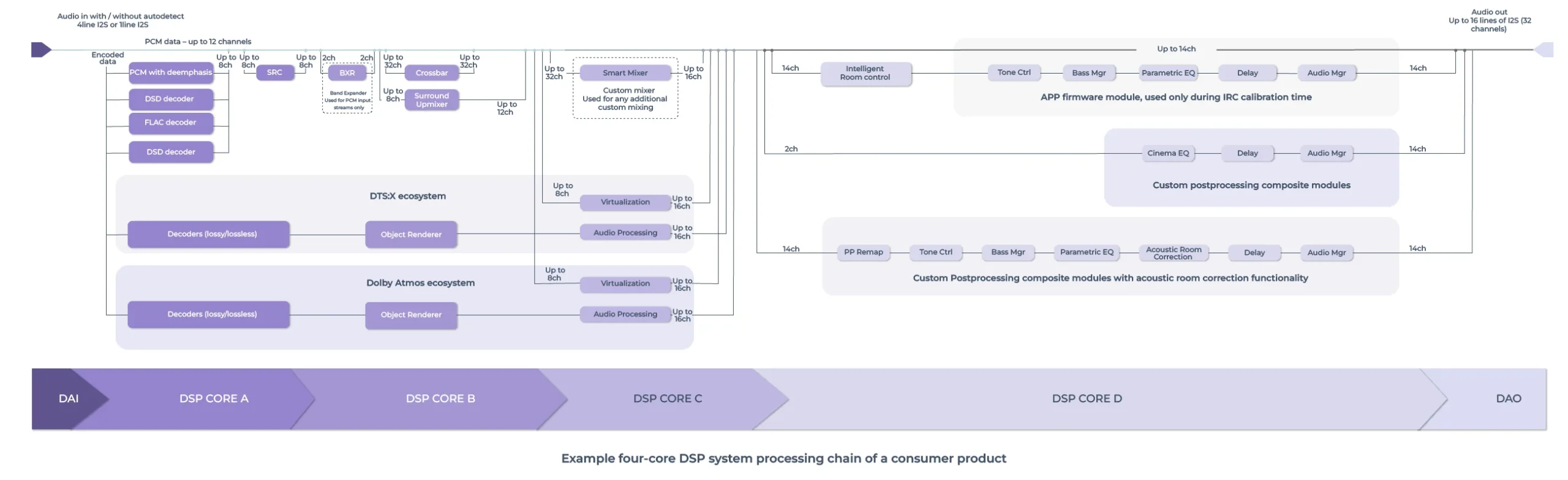
Figure 2: An example of signal processing pipeline scenarios integration into an AVR product.
More importantly, it changes the role of system integration itself. Instead of treating vendor technologies as fixed processing islands that must simply be accommodated, the framework allows them to participate as controllable elements within a larger system architecture.
This creates opportunities for pipeline restructuring, cross-technology alignment, and reuse strategies that would otherwise be difficult to achieve.
The result is greater freedom to make architectural decisions without being constrained by the original assumptions of individual technologies.
Built-in Audio Primitives and Rapid Development
The framework includes a library of reusable audio primitives: Gain, Delay, Filters, Mixing utilities
These primitives enable:
- Rapid module prototyping
- Faster tuning iterations
- Reduced dependency on low-level DSP development
Critical Feature: Code Overlay Mechanism
Embedded audio platforms operate under strict memory constraints. Loading a complete software stack for every supported format is often impractical.
Consider a typical format transition:
User switches from a Dolby Atmos stream to a DTS stream.
In a traditional implementation, the entire pipeline may need to be reloaded, resulting in increased latency and a degraded user experience.
The framework addresses this through a code overlay mechanism.
The system is partitioned into independently loadable segments:
- Core components - including the OS, processing, and post-processing - remain resident
- Only format-specific decoders are swapped dynamically
This results in:
- Reduced time-to-audio
- Seamless format transitions
- Efficient memory utilization
The approach allows the system to adapt to changing audio formats without repeatedly rebuilding and reloading the complete processing environment.
Practical Impact
By introducing a structured audio framework, development teams gain benefits at both the engineering and product levels.
Engineering Efficiency
- Reduced integration complexity
- Reusable module ecosystem
- Faster development cycles
System Scalability
- Efficient use of multi-core DSP architectures
- Flexible pipeline restructuring
- Reusable system architecture across platforms and product variants
Product-Level Benefits
- Reduced time-to-audio
- Consistent behavior across formats
- Simplified product variant management
The benefits extend beyond individual products. For platform and hardware vendors, the framework provides a reusable architectural foundation that scales across product generations, variants, and customer-specific configurations. For OEM and ODM customers, it reduces integration complexity, shortens product bring-up cycles, and helps deliver more predictable and reliable system behavior.
In our experience, once technologies conform to a common execution and control model, integration shifts from a development challenge to a configuration exercise. Processing pipelines can be assembled, modified, and reused across products by replacing or rearranging compatible functional blocks. As a result, functionality that would traditionally require months of platform-specific integration effort can often be deployed within weeks across new products and customer programs
Enabling Cross-Technology Integration by Design
Beyond system optimization, the framework lays the foundation for integration and interoperability of multiple audio technologies within a common architecture.
By enforcing standardized interfaces and controlled execution, previously incompatible technologies can be aligned within a single system architecture.
This enables:
- Seamless integration of vendor technologies
- Consistent post-processing strategies
- Unified control over the entire audio pipeline
In this model, interoperability is not an afterthought. It is a consequence of designing the system around common interfaces, controlled execution, and managed data flow from the outset.
Conclusion
The transition from integration to shipping is where audio systems either succeed or fail.
Without structure:
- Complexity scales uncontrollably
- Integration effort is repeated
- System behavior becomes unpredictable
With a framework-driven approach:
- Architecture becomes consistent
- Execution becomes controllable
- Systems become scalable and reusable
The long-term value of this approach extends beyond any individual product. The framework allows engineering effort to accumulate rather than restart with each new product. Knowledge, integration patterns, and system architecture become reusable assets instead of project-specific outcomes.
Ultimately, this enables teams to move beyond assembling components and toward engineering complete audio products with intent.
In embedded audio systems, integration is not the end of the process – it is where the real engineering is.