
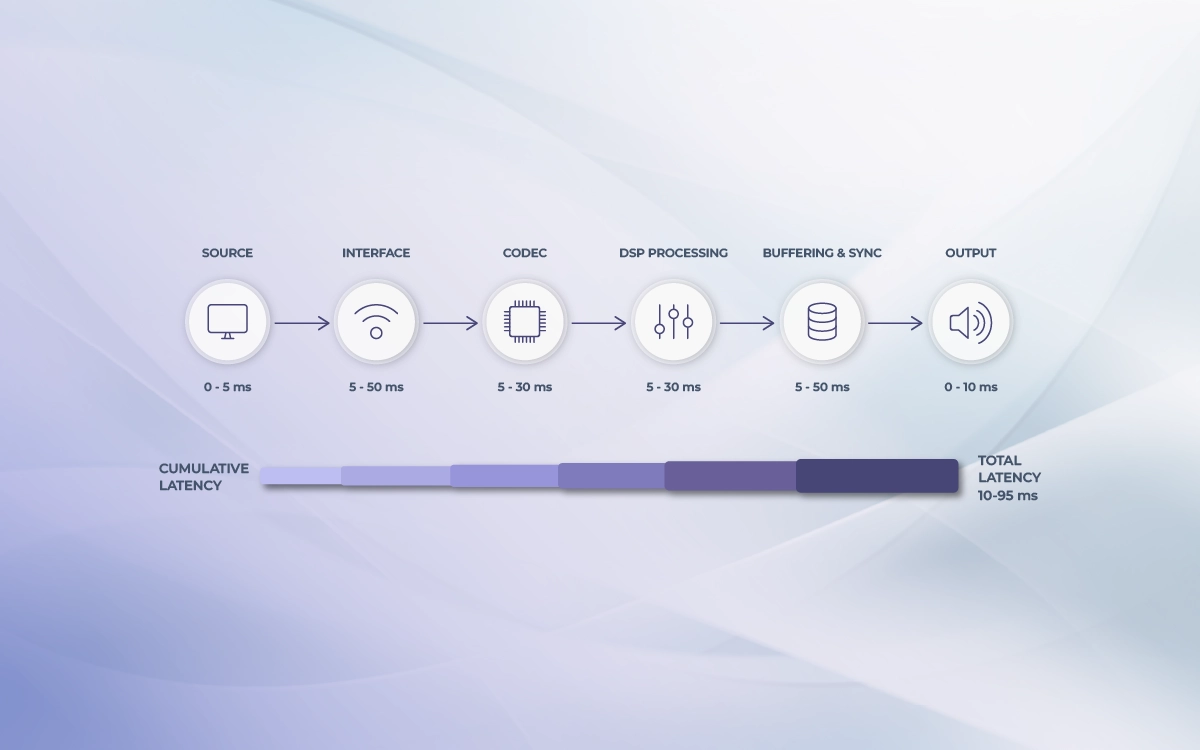
Every Home Audio system introduces delay. Some of that delay is unavoidable. Some of it is intentional. And some of it is the result of engineering decisions that compound across layers until the total becomes a problem. Understanding where latency originates, how it is measured, and how it is controlled is not an academic exercise. It is a practical requirement for building products that meet certification standards and deliver the experience users expect.
The Challenge: Latency Is Not One Problem
The most common misconception about audio latency is that it has a single source. In practice, latency in a Home Audio system accumulates across every layer of the signal chain, and each layer behaves differently.
The interface is the first contributor. Bluetooth latency spans a wide range, roughly 50 to 250 milliseconds depending on the codec in use. Legacy codecs such as SBC and AAC sit at the upper end of that range, which makes them unsuitable for video-synchronized playback in a movie and even more so for interactive use. More recent developments, including aptX Low Latency, aptX Adaptive, and LE Audio with the LC3 codec, bring latency down to a few tens of milliseconds, although even that remains perceptible in timing-sensitive scenarios. Wi-Fi-based audio systems manage this differently, using synchronization protocols derived from PTP (Precision Time Protocol) to align playback across multiple devices by introducing a controlled buffer that all devices share. eARC (Enhanced Audio Return Channel) changed the landscape for HDMI-connected systems by supporting high-bandwidth audio without compression, removing a significant source of delay that its predecessor, standard ARC, could not avoid. However, the bandwidth increase from 1 Mbps in standard ARC to 37 Mbps in eARC introduces a new engineering challenge: buffering a high-bitrate uncompressed audio stream demands substantially more memory, and that memory cost must be accounted for in the system design.
The codec is the second contributor. When a source device sends uncompressed LPCM audio, the receiving system has samples ready for the DAC with minimal processing overhead. When the source sends an immersive compressed audio bitstream, the DSP must first decode the stream, position audio objects in threedimensional space, and complete the rendering process before any output is possible. These are not equivalent workloads, and their latency profiles reflect that difference.
The relationship between audio and video processing paths introduces a third layer of complexity. When heavy video processing such as frame-rate interpolation or 4K upscaling causes the video pipeline to lag behind audio decoding, the audio signal must be held in a delay buffer until the corresponding video frame is ready. When the situation is reversed and complex object-based audio decoding takes longer than video pass-through, the video signal must be buffered instead, which carries a significantly higher memory cost. Either scenario, when it crosses the human perception threshold, produces a lip-sync error that breaks immersion and degrades the listening experience. That threshold is well defined: according to ITU-R BT.1359, the misalignment becomes detectable when audio leads the picture by more than 45 milliseconds or lags it by more than 125 milliseconds, while broadcast-oriented recommendations such as ATSC set even stricter operational limits of 15 milliseconds lead and 45 milliseconds lag. Managing these two paths and keeping them aligned within these tolerances is a core requirement of any Home Theater product.
Acoustic processing and room calibration systems add a further layer. These typically use Finite Impulse Response (FIR) filters to correct frequency response and phase behavior. FIR filters introduce a fixed latency that is proportional to the filter length. This latency is predictable and measurable, but it is real and must be accounted for in the total system budget. IIR filters process faster but do not offer the same phase correction capability, which represents a genuine engineering trade-off rather than a clear preference.
Finally, some latency is introduced deliberately. Speaker distance alignment requires the system to delay the signal sent to closer speakers so that sound from all speakers reaches the listener at the same time. A speaker positioned one meter closer than its pair requires approximately 3 milliseconds of added delay to maintain a coherent soundstage. Lipsync compensation works on the same principle, delaying audio to match video that has been delayed by display processing. These intentional delays are necessary for a correct listening experience, but they must be precisely controlled.
Gaming represents a particularly demanding edge case within the latency conversation. Unlike film or broadcast content, interactive playback cannot be compensated with buffering, because the system cannot know in advance what the player will do. Every millisecond between a player's action and the corresponding audio response is directly perceivable, and delays that would go unnoticed in passive viewing quickly break the sense of responsiveness in a game. This is why immersive audio in gaming environments sets a fundamentally different latency target than the same technology applied to passive content consumption, and why meeting that target requires a level of end-to-end latency control that goes well beyond standard Home Audio requirements.
Measurement and Certification
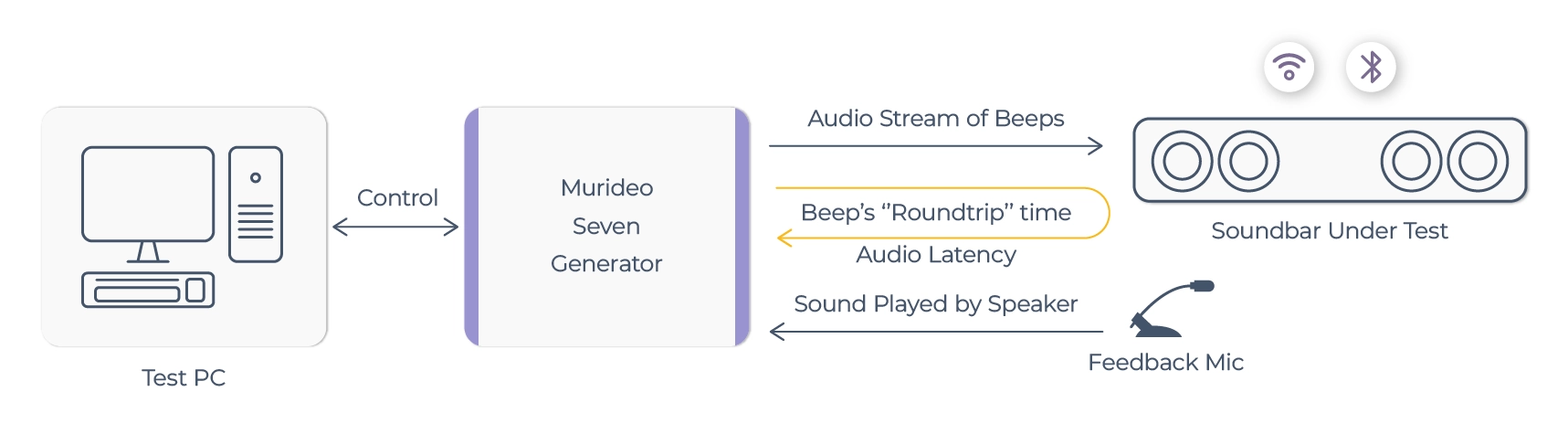
Figure 1. Typical Latency Measurement Setup with the Murideo Seven Generator
Latency cannot be optimized without being measured accurately. In Home Audio development, that measurement requires both specialized equipment and a disciplined methodology.
The MURIDEO SEVEN Generator is a Dolby-approved test device for Dolby Vision and Dolby Audio certification, and it provides the measurement precision that development and validation workflows require. However, accurate system-level measurement is only part of the picture. Isolating the latency contribution of the core DSP processing algorithms, separate from ADC and DAC conversion overhead, peripheral component delays, and hardware initialization routines, requires a dedicated measurement approach.
This is achieved through a Gray-Box Testing methodology that combines input and output verification with targeted instrumentation inside the digital domain. Rather than feeding streams through consumer inputs and capturing analog output, audio data is injected and captured directly in the digital domain via I2S interfaces, bypassing analog conversion stages entirely. The DSP firmware is instrumented to inject a coded synchronization marker at the precise clock cycle when audio processing begins. By measuring the time delta between that marker and the start of the parsed audio output, it becomes possible to determine the exact processing duration of the DSP algorithms in isolation, without contamination from surrounding hardware.
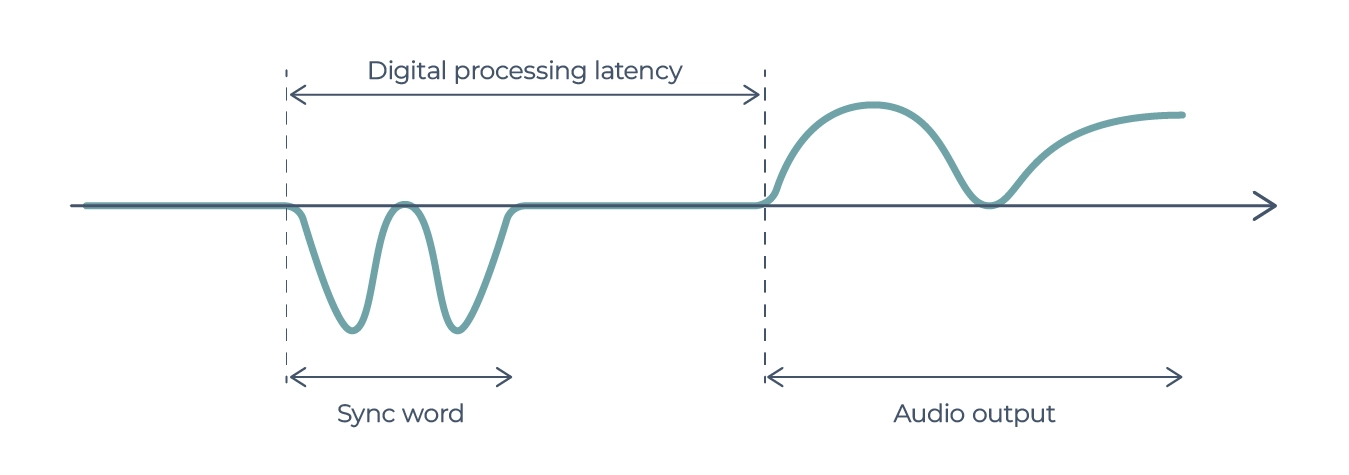
Figure 2. Injection of the Sync Pulse at the Input and Capturing the Signal at the Output
The Audio Framework plays a direct role in enabling this level of measurement precision. By abstracting execution pipelines into discrete processing blocks, the Framework allows engineers to hook into the firmware's internal state machine and inject synchronization markers at the precise point of execution. Because the Framework manages sample-accurate memory buffers and direct I2S DMA transfers without additional middleware abstraction layers, there is no framework-level jitter or scheduling overhead that could skew measurement results. This architectural transparency turns latency evaluation from a trial-and-error exercise into a deterministic engineering process, giving development teams the data they need to calculate and allocate memory delay buffers accurately and validate custom audio algorithms against HDMI 2.1 automatic lip-sync timing requirements.
This level of measurement precision is what separates latency optimization from guesswork. Dolby defines maximum latency thresholds as part of its certification requirements for licensed products, and achieving those thresholds consistently across all supported formats, source types, and operating conditions requires deliberate engineering from the earliest stages of development. Problems that appear late are significantly more expensive to resolve than those identified during architecture and integration.
The Solution: Hardware and Software Together
There is no single fix for audio latency. The contributions from interfaces, codecs, filters, and deliberate alignment delays each require a different response, and the total system budget must be managed across all of them simultaneously.
Context switching with inadequate buffering is a latency contributor that often goes unnoticed until late in development. A balanced Audio Framework controls this by defining buffer allocation and module scheduling as part of the architecture rather than leaving them to runtime behavior. When the Framework is properly tuned, context switches happen on predictable boundaries and their contribution to total system latency stays within budget.
At the software level, architectural decisions made early in development have a direct impact on latency behavior. The Audio Framework addresses this through three coordinated components: a deterministic scheduling engine that enforces a strict and predictable execution order across all processing modules, a dedicated streaming engine that manages buffering and inter-module data transfer, and a memory manager that controls resource allocation in line with real-time processing constraints. Together, these components ensure that latency is a design parameter built into the system architecture rather than an emergent property of runtime behavior. Buffering scheme selection and module synchronization are defined at the framework level, which keeps the processing pipeline flowing without interruption and makes total system latency predictable and measurable from the earliest stages of development.
At the hardware level, Audio-Centric SoC design addresses the sources of non-deterministic latency that software cannot fully eliminate. When data movement between input and output is handled autonomously through dedicated DMA and separated audio bus architecture, the DSP is not competing with other workloads for bandwidth. The result is a processing environment where timing behavior is consistent regardless of system load, which is the prerequisite for meeting tight latency budgets across all operating conditions.
The combination of these two approaches, applied by engineers with deep experience in audio DSP optimization and codec integration across multiple platform generations, is what makes the difference between a system that meets its latency budget in ideal conditions and one that meets it reliably in production. Validated on commercial silicon, a custom audio framework running on a dedicated CS498xx DSP achieved immersive audio playback with latencies scaling between 10 ms and 95 ms depending on active codec configurations, tested under real-world operating conditions rather than idealized benchmarks.
Strategic Benefits for OEMs
Certification Confidence: Meeting Dolby's latency thresholds and equivalent requirements for other compressed audio formats requires both measurement capability and optimization experience. Access to approved test equipment, a proven measurement methodology, and a team that has navigated these requirements across multiple product generations significantly reduces certification risk.
Predictable Latency Across Formats: A system built on a structured Audio Framework and an optimized hardware platform delivers predictable latency behavior across different input formats, from LPCM to immersive compressed audio bitstreams. Format transitions do not produce unexpected latency spikes.
Controlled Audio-Video Alignment: Understanding and managing the relationship between audio and video processing paths, including the memory implications of each buffering scenario, is a prerequisite for products that must meet automatic lip-sync correction requirements. This requires system-level visibility that component-focused teams often lack.
Reduced Late-Stage Risk: Latency problems identified during architecture and integration are far less costly than those discovered during certification or after product launch. Early measurement, structured development, and experienced engineering teams compress the gap between first integration and final validation.
End-to-End Ownership: Managing latency across interfaces, codecs, spatial processing, and deliberate alignment delays requires visibility into every layer of the system. Teams that understand the full signal chain, from source to speaker, can make trade-offs that teams focused on individual components cannot.
Conclusion
Latency in Home Audio is the cumulative result of decisions made at every layer of the system. No single optimization resolves it, and no single engineering discipline owns it. The path to a product that meets certification requirements and delivers a responsive, synchronized listening experience runs through hardware design, software architecture, measurement discipline, and the kind of cross-domain experience that only comes from having worked through the full evolution of Home Audio technology.
Getting time back in a Home Audio system is an engineering problem. Solving it requires treating it as one.