
The Hidden Cost of Audio IP Integration
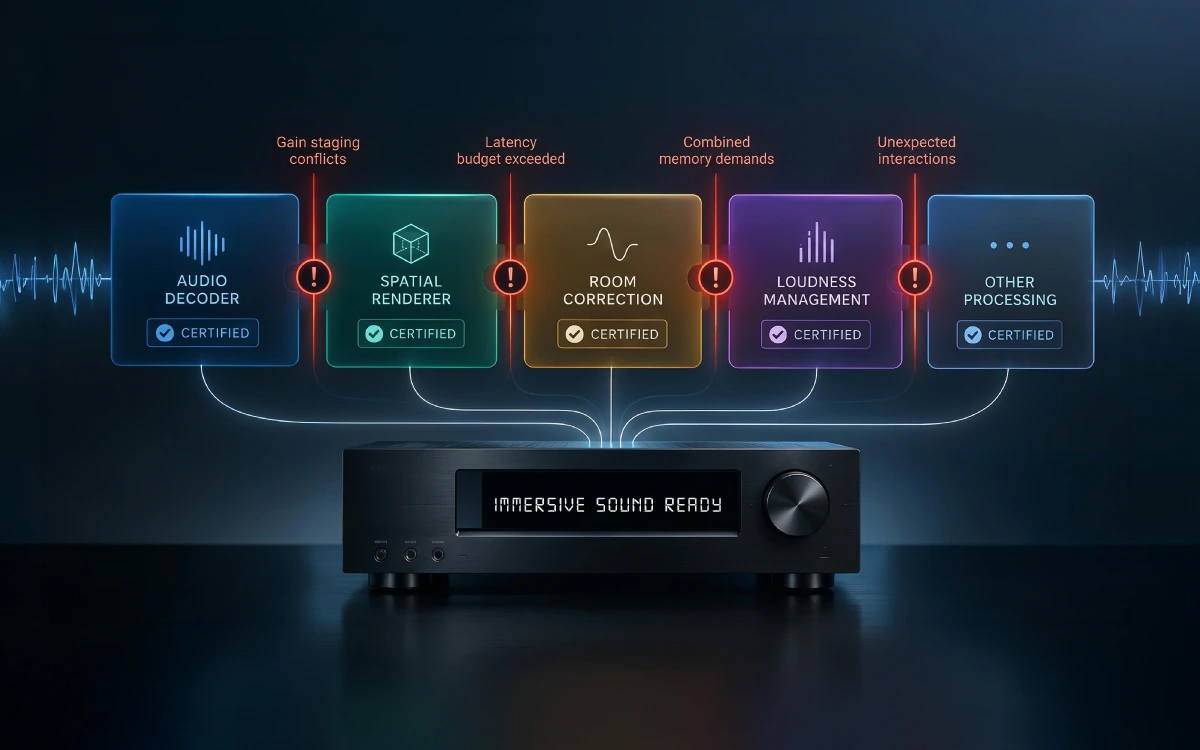
Modern home theater systems - from AVRs to soundbars - depend on a complex stack of audio processing technologies sourced from multiple IP vendors. Each technology arrives individually tested, certified, and documented. But individually certified components do not automatically make a system ready to ship. Assuming they do is one of the most expensive misconceptions in consumer audio firmware development.
This article examines why combining audio processing IP from different vendors creates problems that no single vendor is positioned to solve, why those problems often surface late in the product lifecycle, and what the downstream cost looks like in engineering effort, hardware BOM, and time-to-market.
End users do not experience individual technologies such as Dolby, DTS, room correction systems, or loudness algorithms. They experience the product as a whole. For audio brands, the challenge is therefore not simply to integrate multiple certified technologies, but to maintain a consistent and recognizable audio identity across different processing paths. As the number of audio technologies within a single device grows, maintaining that consistency becomes increasingly difficult.
The Misconception That Sets the Trap
When a product team assembles the audio processing stack for a new platform, the conversation often sounds like this:
"We have the immersive codec from Vendor A, the room correction library from Vendor B, and the loudness management module from Vendor C. They're all certified. We just need to integrate them."
On the surface, this is a reasonable assumption. Each library has passed the relevant certification program. Each vendor's documentation describes an API. The engineering estimate for integration looks tractable - perhaps a few weeks per module. The product schedule is built on this assumption.
The problem is not with any individual library. The problem lives in the spaces between them - and no vendor owns those spaces.
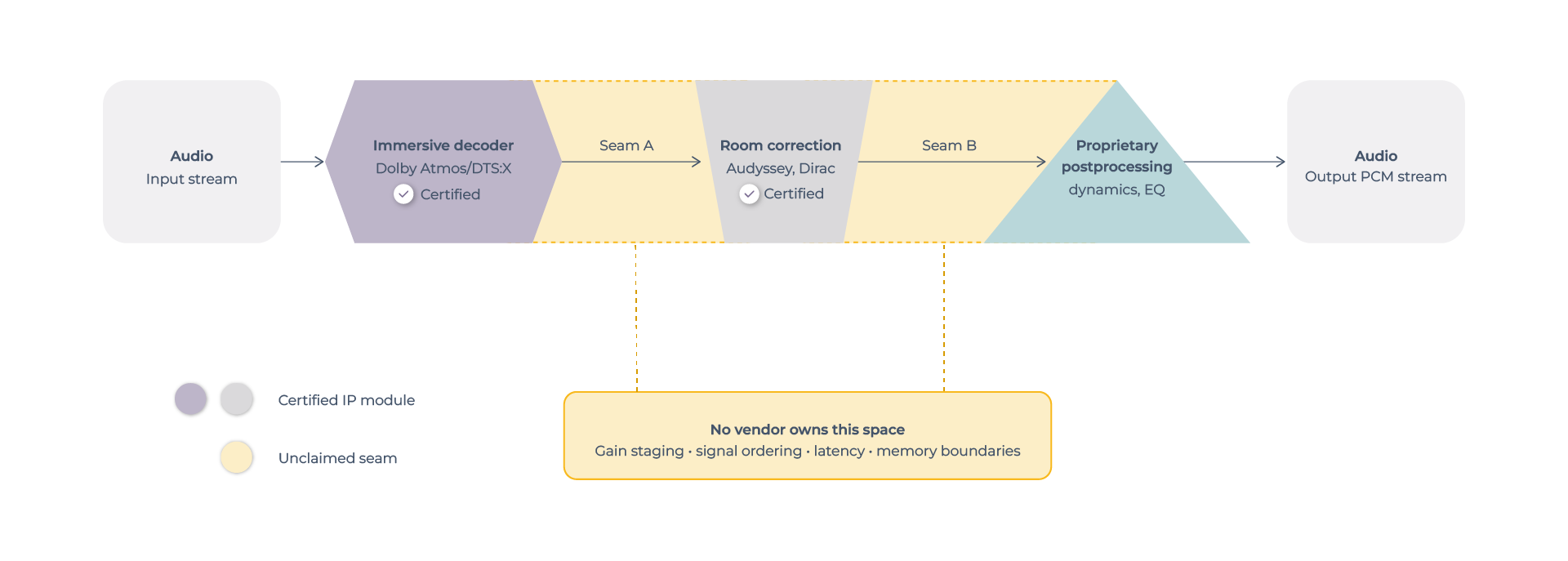
Figure 1. The Integration Seam Problem
Each module is individually certified. The interactions between them are not.
When Independently Designed Technologies Meet
The audio processing modules in a typical home theater product - spatial audio renderers, room correction engines, loudness and dynamics processors - are each designed, optimized, and tested in isolation. This is rational from each vendor's perspective, but structurally problematic from the system integrator’s.
The resulting challenge is not one of compatibility alone, but of controllability: the ability to predict, manage, and maintain consistent system behavior across independently developed processing technologies.
Signal Chain Ordering
Each audio processing block makes implicit assumptions about the signal it receives: its dynamic range, spectral characteristics, and, in some cases, the representation of spatial metadata. When these assumptions are not met, the result is not necessarily an obvious error message - it may be a subtly degraded listening experience that is caught only by human listening test, late in verification.
Level and Gain Staging
Spatial audio renderers, loudness algorithms, and room correction engines all affect signal levels. Each may apply gain adjustments according to its own internal model, with no awareness that other modules are doing the same. The combined result can produce unexpected clipping or loudness inconsistency between playback modes - not because any single module is wrong, but because the interactions between them were never specified.
Latency Budgets
Processing latency is a finite resource, particularly in AVR applications where audio-video synchronization is a hard requirement. Each binary library carries its own internal latency, often undocumented, configuration-dependent, or only approximately characterized. When three or four such modules are chained, the cumulative latency can breach the system budget - a discovery that, made late, can require both hardware and software changes.
Memory Footprint Conflicts
Third-party audio IP libraries, often delivered as binary blobs, manage their own heap and stack allocations internally, with no coordination mechanism for sharing resources across modules. Memory footprint estimates provided by vendors are typically measured in isolation under controlled conditions. In an integrated system, with multiple blobs active concurrently, the actual footprint reflects their combined worst cases scenarios - often substantially more than planned.
The Black Box Problem
The precompiled binary blob is the dominant unit of delivery for commercial audio IP. This format protects the vendor’s proprietary algorithms and offers the promise of plug-and-play integration. However, it also creates a fundamental asymmetry during integration: the integrating team can observe inputs and outputs, but cannot inspect, instrument, or modify what happens inside.
When an unexpected interaction occurs between two blobs - a level discontinuity, an artefact under specific content, or a certification test failure - the integrating team must diagnose a problem involving two opaque components. The natural response from each vendor, when presented with a support ticket, is to verify that their library behaves correctly in isolation. It does. The problem exists at the boundary - but no one owns the boundary.
The limitation extends beyond visibility. Even when components can successfully exchange data, there is often little practical control over how their behavior aligns with neighboring processing stages. In this sense, the challenge is not whether technologies can coexist, but whether they can be collectively managed to produce predictable system-level outcomes.
The ownership gap: Vendor A confirms their module passes all internal tests. Vendor B confirms the same. The system integrator is left with a defect that belongs to neither component in isolation - and a product schedule that does not account for resolving it.
Across more than two decades of client engagements, we have seen this pattern recur in different forms: timing conflicts, heap collisions, gain staging errors, latency budget violations. The failure mode varies, but the dynamic is consistent: the seam between certified components is unclaimed territory.
One Product, One Sound
Leading consumer audio brands invest significantly in defining a sonic signature - a consistent tonal character and spatial presentation that listeners associate with their products. Maintaining that signature across playback modes - stereo, multichannel, object-based spatial, virtual surround - is a product requirement, not a preference.
From the listener's perspective, the distinction between processing technologies is largely invisible. Users do not evaluate Dolby, DTS, or any individual subsystem in isolation; they evaluate the product. Yet its perceived character can change significantly depending on which processing chain is active. Maintaining a consistent audio identity therefore becomes a system-level interoperability challenge, not a tuning exercise within any single technology.
Fragmented audio IP makes this exceptionally difficult. Each processing module exposes its own tuning parameters: EQ curves, spatial rendering presets, loudness targets, dynamics behavior. Across vendors, the parameter spaces and control semantics differ, while interactions across module boundaries are complex and often non-linear.
The result is a rapidly expanding space of corner cases. A parameter that controls perceived loudness in stereo mode has a different effect when the spatial renderer is active, which changes again when the room correction filter is engaged. Tuning for consistency across all mode combinations becomes a combinatorial problem - one that cannot be exhaustively solved under a typical product schedule.
When Integration Problems Become Product Problems
These integration challenges do not remain contained within the firmware engineering team. They propagate outward, affecting product cost, schedule, and quality in ways that can be difficult to trace back to their root cause.
Hardware Over-Specification
One common early-project failure is not technical, but one of estimation. Teams evaluate each audio IP library independently and confirm that it runs within the available resource budget on a given SoC. The problem surfaces later, when the combined footprint of multiple blobs exceeds that budget. By then, the hardware platform has been selected and the BOM committed.
The response may be to specify up: a more capable SoC tier, an additional DSP, or larger memory components. These are costly changes made under schedule pressure - consequences of a problem that was not visible when the hardware decision was made.
Certification Failures and Recertification Cycles
Third-party audio IP certification - Dolby, DTS, and others - tests the system behavior against defined test vectors. An integration problem that emerges from the interaction between certified modules - gain staging, signal ordering, or latency, for example - can produce a certification failure even though each module is individually compliant. Resolving it means debugging the boundary between opaque components, under time pressure, and with a certification lab waiting. Recertification adds time and cost to the schedule.
Find the Problem Before Certification Does
Integration issues discovered during module-level development - while the system is still being assembled, parameters can be changed freely, and the full engineering team is engaged - cost a fraction of the same issues discovered at certification or, worse, in a field device.
More than 20 years of audio DSP firmware development across large-volume consumer home-theater programs have shown us that the cost difference between early and late discovery can exceed an order of magnitude. Some late-stage issues require hardware changes; field issues belong to a different cost category entirely.
Yet audio firmware integration often works against this natural cost gradient. Many interoperability problems are emergent: they appear only when multiple components are combined. A conventional assemble-then-test approach therefore pushes discovery toward the point in the program where schedule pressure is highest and architectural options are most constrained.
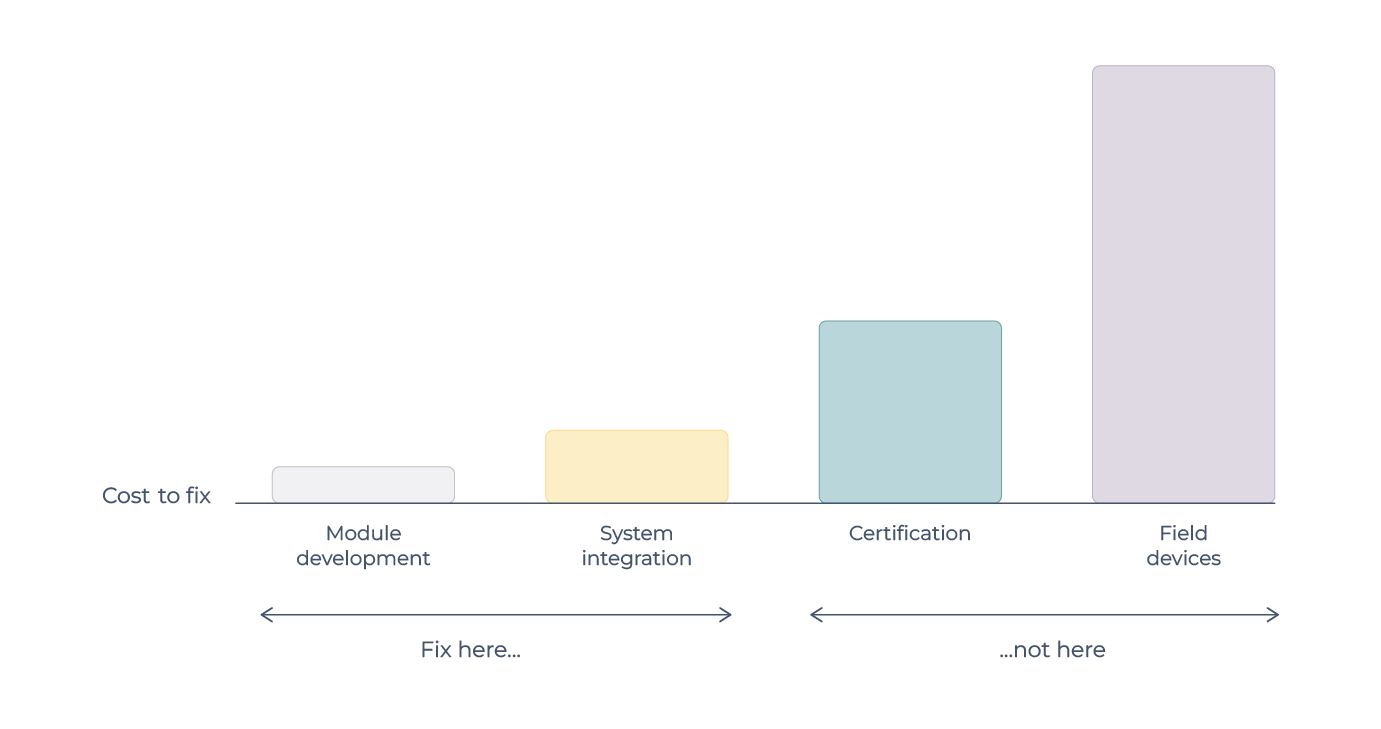
Figure 2. Illustrative relative cost based on RT-RK experience across production audio programs
A rigorous approach to audio IP integration must create the conditions for early discovery: instrumentation at module boundaries, systematic testing of component interactions under real-world content, and explicit ownership of the seams between third-party components. These are architectural and process commitments, not testing add-ons.
The shift-left imperative: Integration boundaries need to be instrumented and tested while the architecture can still change - not first discovered during certification.
The recurring nature of these problems points to a broader architectural limitation: interoperability cannot be solved by treating certified technologies simply as isolated, immutable building blocks.
Achieving consistent behavior across mixed-vendor audio processing chains requires a shift in perspective:
from viewing technologies as isolated black boxes to understanding how processing responsibilities, assumptions, and control points interact across the complete signal path.
Someone Has to Own the Seam
The problems described here share a common structural characteristic: they occur at boundaries that no individual IP vendor is positioned to own. Each IP vendor is accountable for its own module, while the system integrator remains accountable for the product. The seams between certified components - interaction points, gain staging hand-offs, and latency budgets - therefore require explicit ownership.
In our experience, that ownership is claimed either proactively - by teams with the architectural depth and tooling to instrument and test these boundaries early, or reactively - under the pressure of a certification failure or a field report. The difference in cost and schedule impact between these two modes is substantial.
The teams best positioned to claim this ownership are those with deep, bottom-up knowledge of each technology block - not simply as users of a vendor API, but as engineers who understand what each block is doing to the signal, why, and what that implies for other blocks in the chain.
Conclusion
Audio processing IP certification is a statement about a component's isolated behavior. It is not a statement about the system that results when multiple certified components are combined. The gap between component compliance and system behavior is where some of the most expensive problems in home audio firmware development live.
The gap is structural: it exists at the boundaries between technologies, not within the individual libraries themselves. Managing it requires explicit ownership, early-stage instrumentation, and an architectural approach that treats the interactions between components as a first-class engineering concern. As more audio technologies converge within a single product, that system-level discipline becomes
These challenges are structural, but they are not unavoidable. Addressing them requires an architecture that provides consistent control across otherwise independent processing technologies - making their interactions visible, manageable, and testable as part of the complete system.