
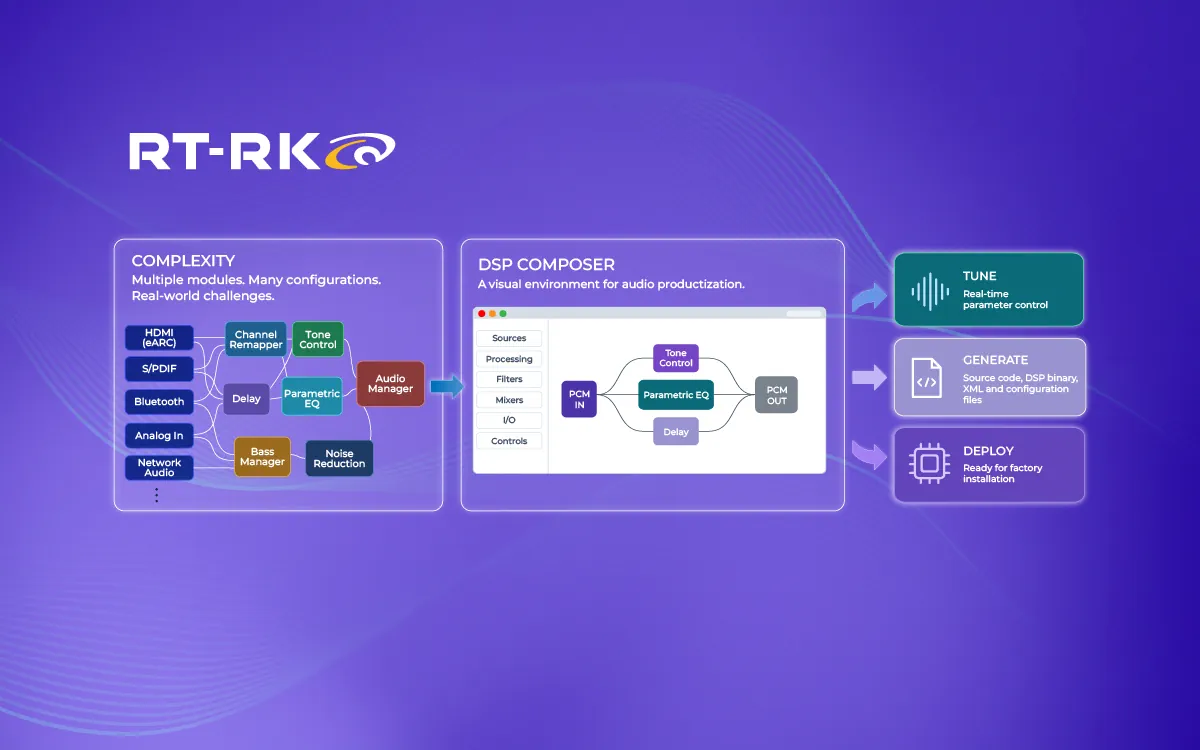
Turning complex audio devices into market-ready products requires more than developing the underlying audio technology. Manufacturers must integrate multiple IP technologies, configure complex processing chains, and fine-tune the audio signal path to create a distinctive listening experience. RT-RK solves this problem with a productization layer built on top of their scalable Audio Framework. This layer exposes framework capabilities through a higher level environment - using tools such as DSP Composer - allowing engineers to easily compose processing flows, configure applications, tune runtime behavior, and prepare deployable solutions without repeatedly working at the level of framework internals. Ultimately, this article breaks down how this system helps manufacturers develop their audio devices faster and more efficiently.
The Path from Idea to Finished Product
Creating an audio device typically involves three main stages: development, verification, and productization. While development builds the core audio application and verification confirms that it performs as intended, productization prepares it for stable operation in a real-world commercial device. This final stage is often underestimated. The device must support different combinations of audio IP and custom postprocessing modules while operating reliably under real-world conditions.
The Productization Obstacles
Productization is one of the most demanding phases of audio device engineering and can significantly affect time-to-market. Engineers must understand the underlying software architecture, combine and configure audio modules, integrate them into existing processing pipelines, manage configuration and parameter tuning, validate system performance, and debug real-time signal-processing issues. Doing this efficiently requires a strong understanding of the entire software stack and framework.
What is the RT-RK Productization Layer?
The RT-RK Productization Layer abstracts the complexity of the underlying Audio Framework through a higher-level environment and visual programming tools. Instead of repeatedly working at the framework level, engineers can configure, tune, and prepare audio applications for deployment through a streamlined development environment.
Using these tools, engineers can:
- Compose processing flows: Easily decide where the sound goes and which filters it passes through.
- Real-time configuration: Change settings on the fly while the system is running.
- Tune runtime behavior: Adjust how the audio sounds in real-time.
- Define switch scenarios: Initialize default audio application for each type of input bitstream.
- Prepare deployable solutions: Quickly pack the software so it is ready for factory installatio
Building and Configuring DSP Applications
Before integration into the main software framework, each DSP application must be configured and verified. Modern audio systems require engineers to manipulate complex processing chains, monitor signal behavior in real time, and evaluate changes in audio quality. Once the signal-processing layout is established, each component must be configured and the necessary files generated for system integration.
A major driver of this system complexity is the reliance on custom postprocessing modules to shape the final audio output. Beyond basic bass boosting and noise reduction, contemporary systems must manage advanced, interconnected modules such as a channel remapper, tone control, bass manager for low-frequency management, a parametric EQ for precise frequency tuning, delay for time alignment, and an audio manager to orchestrate the entire audio ecosystem. Furthermore, today's multi-source environments require the ability to define and manipulate specific switch scenarios, enabling the system to initialize default applications based on the input type dynamically.
Navigating this intricate environment allows companies to quickly adapt their products for different use cases - such as home theaters or automotive audio systems - while efficiently creating their own tuned, configured DSP applications and a unique brand sound with a complex audio postprocessing chain(s) and its variations, as represented in Figure 1.
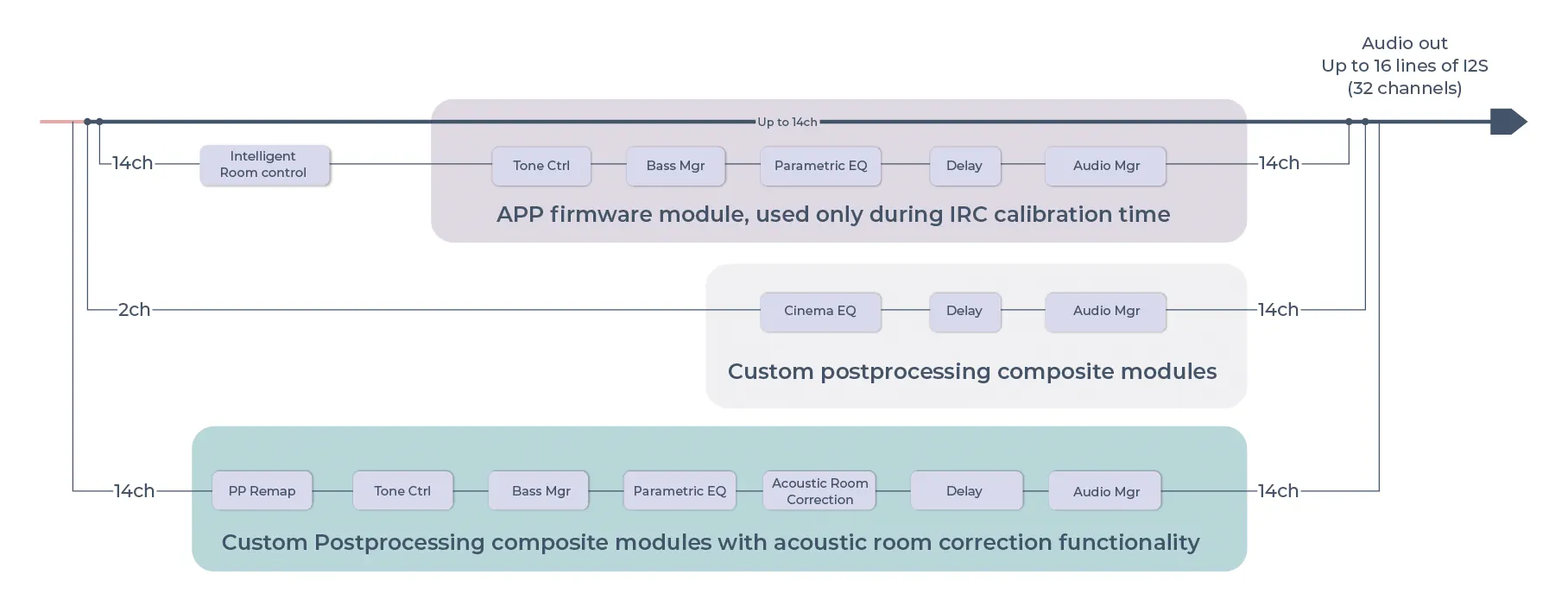
Figure 1: Custom postprocessing chain complexity within DSP application
A Graphical Programming Environment
DSP Composer is a visual programming environment for graphical signal-flow design in audio applications. Integrated into an Eclipse-based IDE and implemented in Java, it supports portability across operating systems. While primarily optimized for single-core DSP development workflows, its architecture also provides a foundation for multi-core development.
Across successive generations, DSP Composer has been used to define processing flows for DSP Condenser, support postprocessing tuning, generate configurations, and turn reusable Audio Framework capabilities into production-ready product variants.
The main Editor window is represented in Figure 2.
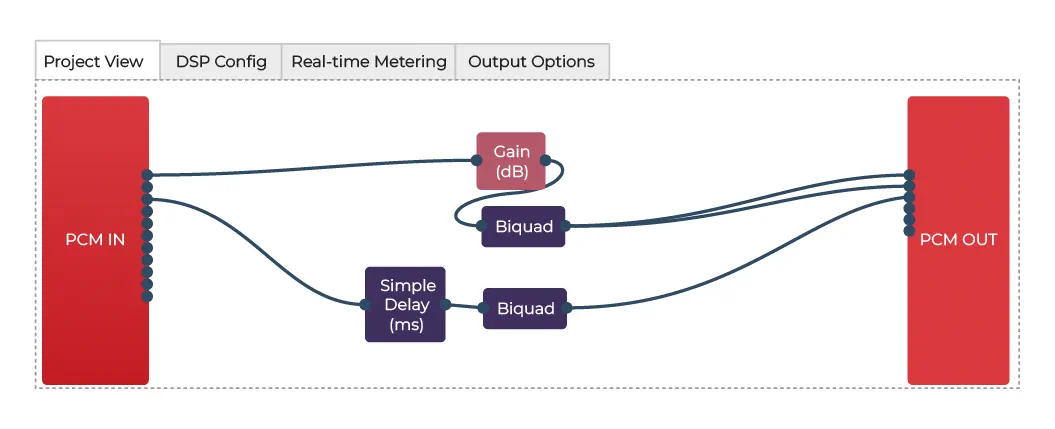
Figure 2: DSP Composer standalone audio application example
Component Architecture
DSP Composer is built around a hierarchical low-code architecture that enables engineers to assemble complex signal-processing pipelines without writing low-level DSP code from scratch.
Primitives
Primitives represent the fundamental building blocks of the system, conceptually similar to blocks in Simulink®. Each primitive consists of a performance-optimized C/C++ implementation and an XML descriptor that defines parameters, input and output ports, data types, default values, and metadata used for validation and visualization. This structure ensures seamless integration between the graphical design environment and the underlying DSP implementation.
Modules
Multiple primitives can be assembled into higher-level processing modules that encapsulate complex functionality. Modules may be built graphically by combining existing primitives or imported directly from third-party IP providers and reused across multiple projects and product generations. This modular design promotes scalability, maintainability, and IP reuse.
Real-Time Tuning and Parameter Control
DSP Composer supports real-time execution and dynamic parameter tuning. Once a design is deployed to a target DSP platform or executed within the PC-based x86 simulator, engineers can modify parameters without recompiling or redeploying the entire application. This shortens the development and tuning cycle by providing immediate auditory and visual feedback.
Live Parameter Interaction
Every primitive (audio processing component) is defined by an XML descriptor that fully describes its configurable parameters, memory layout, data types, and valid operating ranges. Using this information, DSP Composer automatically generates user interface controls that allow engineers to adjust parameters at runtime.
Host-to-Target Communication
The IDE establishes a live communication channel between the development environment and the running DSP application. This communication infrastructure enables real-time interaction with deployed systems.
Direct Memory Mapping
When an engineer adjusts a slider, modifies an equalizer curve, or toggles a control, DSP Composer translates the graphical action into target-specific memory transactions. Processing coefficients and runtime parameters are therefore updated directly within the active DSP implementation, allowing changes to take effect without interrupting audio playback.
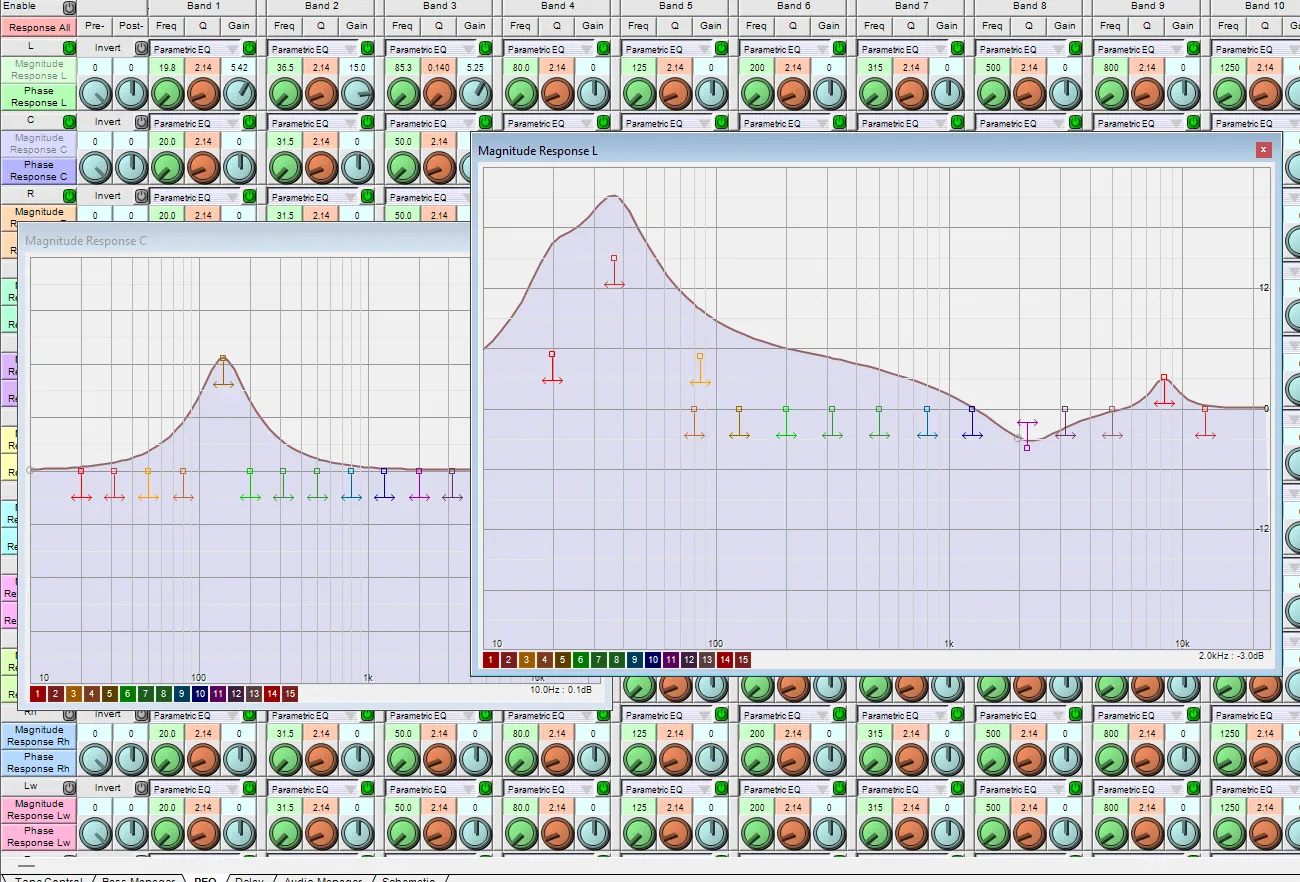
Figure 3: DSP Composer runtime controls enable end-of-line product tuning
Artifacts Generated by DSP Composer
DSP Composer generates the artifacts required to integrate the graphical design into the final product. These include C/C++ headers and source files containing initialization functions and parameter memory addresses, as well as the DSP binary with machine instructions and coefficient tables.
Once the DSP application is designed and tuned, the tool also generates the XML and configuration files required for system integration. These allow the embedded software team to initialize the DSP, load the audio processing graphs, and expose tuning parameters to the user interface without rewriting the core algorithms.
The generated artifacts are compatible with other visual programming tools in the ecosystem, such as DSP Condenser, which is used to manage and bundle audio processing chains, handle different use-case applications, and finalize the product image for deployment.
These integration tools also allow engineers to define switch scenarios that automatically handle changing audio inputs. For each input bitstream type, the system initializes a specific default audio application. This ensures that every incoming audio format is instantly paired with its correct processing chain.
Comparative analysis: With and Without DSP Composer
To understand the value of this solution, consider the simple task of building an audio pipeline with a 3-band Equalizer (EQ) and a Volume Control. In a traditional development workflow without DSP Composer, this process requires manual coding: an engineer must write raw C or assembly code for the mathematical filter equations, then perform external coefficient calculations in tools like MATLAB and manually paste them into the source files. Furthermore, because audio buffers are hardcoded to route data statically from the EQ to the Volume function, any customer request to change a filter frequency forces the engineer to recalculate coefficients, rewrite the code, recompile the firmware, and re-flash the hardware, turning a simple tuning adjustment into a multi-step iteration involving recalculation, code changes, recompilation, and reflashing.
With DSP Composer, the same workflow is handled graphically. An engineer places an EQ block and a Volume block on the canvas and connects them to define the processing flow. When parameters are adjusted, the tool calculates the required filter coefficients in real time. Once the application is configured and tuned, DSP Composer generates the required XML, code, and binary artifacts for integration.
Conclusion: Productization Empowerment
By combining a scalable audio processing framework with a high-level graphical development environment and standardized APIs, DSP Composer allows manufacturers to focus on what truly differentiates their products - the application configuration and sound experience itself. Rather than investing significant engineering resources in low-level DSP infrastructure, teams can rapidly design, deploy, and refine DSP applications while developing their own signature sound, creating a unique acoustic identity. This comprehensive approach enables manufacturers to accelerate feature development, reduce integration complexity, improve software maintainability, shorten time-to-market, reuse designs across product families, and deliver differentiated audio experiences. In this way, the RT-RK Productization Layer helps turn reusable audio technology into differentiated products with their own distinctive sound.
These tools have been successfully deployed across multiple hardware platforms that we supported, spanning several generations of Cirrus Logic DSPs. This includes modern high-performance processors like the CS49844, as well as legacy platforms from the CS498xx, CS495xx, and CS496xx families. Our clients have successfully used the tool across these generations in real-world production environments, demonstrating its long-term stability and commercial value in mass production.